Search This Blog

Tuesday, November 27, 2012

Warsaw Meeting


We arrived in Poland to meet with the Bishop Jerzy Samiec of the Evangelical Augsburg Church in Poland. The church today has about 70,000 members. At the end of World War II, about 200,000 Lutherans remained in Poland. Since WWII, most of the decrease can be attributed to a low birth rate and the departure of Lutherans to other countries for better opportunities. Prior to the World Wars, approximately 1,000,000 Lutherans lived in Poland.

In our conversation, we explored for discussion between the LCMS and the Evangelical Augsburg Church in Poland. The meeting was positive. In the evening we drove to Slovakia, for a trip to Budapest.


Important Dates between 1573 and 1919.


Important Dates between 1920 and 2002.


Old Town Market In Warsaw.


- Rev. Dr. Albert B. Collver, Director of Church Relations.

- Posted using BlogPress from my iPad

Location:Sládkovičova,Žilina,Slovakia

Sunday, November 25, 2012

LUTHERANISM IN POLAND

LUTHERANISM IN POLAND


As I sit on the Last Sunday of the Church Year in the airport in Minneapolis waiting for a flight to Poland, I had opportunity to read a bit about Lutheranism in Poland. The initial reach of Lutheranism on Poland began in 1518 when some adopted the Reformation message early. Lutheranism in Poland has a sorted history of union and persecution. Before WWII, an estimated 800,000 to 1 million Lutherans lived in Poland. After WWII, the number decreased to 200,000 as reported by the Christian Century 28 August 1946.
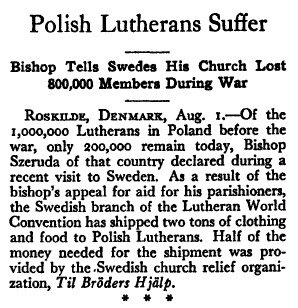


The struggles of the Lutheran Church in Poland call to mind the Gospel Reading for the Last Sunday in the Church Year when Jesus said, "My kingdom is not of this world." (John 18:36)


Below is an article by J.T. Mueller on Lutheranism in Poland from 1951.


abc3+


Mueller, J.T. “Lutheranism in Poland.” Concordia Theological Monthly (March 1951): 204–207.


Of the uncounted Christians who in Eastern Europe suffered persecution under the tyrannical rule of anti-Christian totalitarianism, Lutherans admittedly form a very large part. German, Polish, Latvian, Estonian, Lithuanian, and other Lutheran believers were subjected to almost unspeakable torments by the forces of darkness which by God's permission were unloosed during the past decades.


In England the escaped Polish Lutherans, in 1940, founded the Polish Research Center, with headquarters in London, which so far has published about a dozen brochures on the various phases of the great tribulation which Polish evangelicals had to endure. One of these, which bears the title The Protestant Churches in Poland and includes an account of the vicissitudes of Lutheranism in Poland, was added to the list in 1944. A copy of this interesting study was submitted to the writer by the Rev. W. Fierla, senior pastor and spiritual leader of the Polish Lutherans in England. It is from this instructive narrative of how Lutheranism fared in Poland that the following historical facts are taken.


Before Lutheranism came to Poland, there had been introduced into the land Protestant influences stemming from Wiclif and Hus. Hence, when Luther began his work of Reformation in Germany, he soon had ardent followers also in Poland. In 1518 the Dominican James Knade adopted Luther's teachings in Danzig, which John Laski, the primate and archbishop of Gniezno, tried in vain to suppress. In 1523 King Sigismund opposed Lutheranism, but the movement by this time had become so potent that he was unable to enforce the order which he had published against the new religion. A chief defender of the new faith was Seklucian, who in 1540 published the Augsburg Confession, which was widely read by the people because it was written in a clear and simple style. Thus the Lutheran Church in Poland very soon lost its exclusively German character, especially when it was adopted and advocated by the Polish gentry. At the Diet of Cracow, 1536—1537, the gentry demanded equal regulations for clergy and gentry, especially in the matter of military service, the secularization of the ecclesiastical estates, the limitation of dues paid to the Holy See, the safeguarding of the higher ecclesiastical offices for the gentry, and others. This shows the strength of the evangelical movement.

204


BRIEF STUDIES


205


However, since the wealthier Polish gentry sent their sons for the completion of their education not only to Germany, but also to Switzerland, there were infused into the Polish Lutheran movement also Zwinglian and Calvinistic elements; and owing to eminent Calvinistic teachers, the Polish gentry in many cases abandoned Lutheranism for Calvinism. In 1552 there appeared the New Testament in a Polish translation by Seklucian, who later published also his sermons that greatly stimulated the Lutheran Reformation movement. The complete Polish Bible appeared in 1563. Since it appeared in the city of Brest, it became known as the "Brest Bible." Thirty years later, in 1593, the Jesuit priest Wujek, in defense of the Romanist teachings, published his own translation under the auspices of the Roman Curia. By 1555 Protestantism had become so powerful in Poland that Pope Paul IV applied to King Ferdinand for protection of the Catholic religion in Poland against the new and false Lutheran teachings. By this time the Polish Protestants had become so active in spreading their faith that almost all Poland seemed ready to embrace the doctrines of the Reformers. In 1556 there began a movement to settle the doctrinal differences between the Lutherans and the Calvinists; but while the Protestants united to free themselves from the Roman ecclesiastical courts, the Lutherans in general were disinclined to give up their faith.


The Protestant movement in Poland was greatly threatened by the coming of Unitarian teachers who, forced out of Italy since 1542, sought new mission areas in Eastern Europe. At this time Poland enjoyed so much freedom of belief, speech, and press that it was known as the asylum haereticorum. The rapid spread of Unitarianism caused the Polish Protestants: Lutherans, Calvinists, and Bohemian Brethren, to publish in 1570 the so-called Consensus of Sandomir, an agreement that was political rather than religious. It was followed by The Confession, which was supplementary to the Consensus and was published by the same Synod of Sandomir. The rise and spread of Unitarianism also strengthened the Romanist Counterreformation, which directed itself with no less fury against the Protestants than against the Unitarians.


As a result of this Counterreformation the gentry largely became Calvinistic, while the masses remained Catholic. Among the gentry Unitarianism, however, found many protectors, while Lutheranism was engaged in a continuous struggle with Catholicism, Calvinism, and Unitarianism to defend and maintain its teachings. This fight for the Lutheran faith continued till the close of the eighteenth century. When in 1817 the Prussian Union was introduced in Germany, also the


206


BRIEF STUDIES


Polish Lutherans were affected, for also in Poland the United Church Movement led to the founding of a United Evangelical Church.


In 1828 a General Protestant Consistorium for the Lutherans and the Calvinists was formed in Warsaw. But in 1849 the Czar of Russia, who then administered Polish affairs in large areas, renamed this the Lutheran Consistorium, while for the adjustment of Calvinistic affairs a separate body with synodical administration was set up. Since then the spiritual direction of the Lutheran Church was in the hands of a general superintendent. In 1874 the Lutheran parishes of Poland were divided into four dioceses, at the head of each of which was a superintendent. In 1901 there was added a fifth diocese, Piotkrow. In 1897 there were about 350,000 Lutherans in Central Poland, which number far exceeded that of the Calvinists.


The effect of the First World War, 1914—1918, weighed heavily on the Lutherans in Russian Poland. Before its outbreak the Russian government ordered a mass transfer of Lutherans from Polish lands to the depth of Russia on ground of "Germanophilism." The deportation was marked by extreme brutality. But such Protestants as escaped deportation to Russia were persecuted by the occupying German forces who strove to destroy the limited independence which had been assured to the Polish Lutherans by the Russian edict of 1849.


From 1919 to 1939 Lutheranism in Poland enjoyed a period of freedom and prosperity. In 1937 the Lutherans in Poland numbered more than 600,000, while the total number of Protestants at that time was estimated at no more than 830,000.


The sufferings of the Polish Lutherans during the Second World War, however, were far greater than those during the First World War. According to Nazi philosophy, a Lutheran could not be a Pole, and a Lutheran who was unwilling to be a German must be destroyed. In agreement with this principle a sixteen-year-old Protestant boy who told the German authorities that his name had been put on the list of Volksdeutsche without his knowledge and against his will was shot on the spot. More than 10,000 Polish Lutherans were imprisoned and brutally treated because they had not voluntarily declared themselves Volksdeutsche. In the diocese of Teschen not a single Lutheran Polish pastor was left, though almost 100,000 Poles had belonged to the Lutheran Church in that area. In Lodz Gustav Geyer, a well-known textile owner, was condemned to death for refusing to enroll his name on the list of Volksdeutsche, and his factories were confiscated. When the booklet was written, the Second World War was not yet over, nor had the tribulation of the Polish Lutherans come to an end. Nor are they


BRIEF STUDIES


207


ended today. God only knows to what ceaseless and indescribable sufferings the Lutherans are subject who have fallen into the hands of their atheist Russian conquerors.


These few historical facts, gleaned from a monograph rich in details, show, however, how Lutheranism asserted and maintained itself in a land where Catholicism, Calvinism, and Unitarianism constantly waged war on it. The average student of history perhaps knows far too little of Lutheranism in Poland and the Baltic countries. It is only now when Lutheran refugees and displaced persons are telling the story of their Church and its remarkable survival in the midst of perpetual terror that Lutherans, far removed from such horrors, listen to their saga of fortitude and heroic faithfulness to their belief. The Lutheran World Federation is doing much to alleviate their hard lot in life. It also does much to instil into them a new Lutheran consciousness and a new conception of the glory of their being numbered among the thousands of followers of Dr. Martin Luther. Much of this could be sensed at the theological conference at Leicester, England, where we met some of these Lutherans who had come out of great tribulation.


J. T. MUELLER


- Posted using BlogPress from my iPad

Location:Glumack Dr,Minneapolis,United States

Saturday, November 10, 2012

'Remember your roots,' Lutherans told at Georgia conference


'Remember your roots,' Lutherans told at Georgia conference - Chico Enterprise Record
http://www.chicoer.com/news/ci_21970613/remember-your-roots-lutherans-told-at-georgia-conference

PEACHTREE CITY, Ga. — A renowned British scholar cautioned some Lutheran leaders last week not to lose the “treasure chest” of beliefs they’ve inherited from Martin Luther, who led the Reformation in the 1500s.

Alister McGrath, a professor at Kings College in London, was the keynote speaker at an international conference on theology. The gathering was sponsored by the Lutheran Church — Missouri Synod (LCMS), an American denomination, according to a news release sent to this newspaper.

The three-day conference was attended by 120 church leaders who represent 20 million Lutherans in North America, Europe, Latin America, Africa and Asia.

Participants at the conference represent “more conservative” Lutheran churches, according to the Rev. Larry Vogel, associate executive director of the LCMS Commission on Theology and Church Relations.

McGrath, although he’s not a Lutheran, described himself as having “fallen in love with Luther” because of the clarity with which the Reformation leader described the relationship between people and God. Luther said we are “justified” or forgiven because of Jesus, in whom God’s loving heart for us can be seen, McGrath said.

Vogel said McGrath emphasized the need to do more than simply repeat traditional formulas that came out of the Reformation, such as “justification by faith.” He said such language is no longer understood by many people today.

What’s needed, according to McGrath, is to translate such concepts into terms

that make sense now, Vogel said. It’s needed so that modern people will understand that “the saving work of Christ which reveals God’s forgiving acceptance is the great truth we need today in order to be able to live with confidence, peace, and joy.”

McGrath also talked about Luther’s “theology of the cross,” Vogel said. It “shows that faith in Christ sustains people especially in times of trouble and suffering. Human beings are shaped and matured not by life’s easy times, but by passing through testing and trials with faith in Christ and in his willingness to take on human suffering and death.”

At the conference, such matters as marriage and sexuality, the authority of the Bible and the church’s work of responding to human needs were discussed.

Among conference speakers was the Rev. Jobst Schoene, a retired bishop of Germany’s Independent Evangelical Lutheran Church.

Speaking on “life together,” Schoene said, “we are linked together as Lutherans who take their confession seriously.”

He told those attending the conference, “There is still a lot to do: more exchange, for instance (in) theological discussion, exchange of teachers, of servants in the ministry, (and) the practice of intercommunion and intercelebration where there is doctrinal agreement. And if that’s missing — to work for such agreement.”

The International Conference on Confessional Leadership, as the gathering was called, was held in Peachtree City, which is about 20 miles south of Atlanta.

(via Instapaper)

- Posted using BlogPress from my iPad

Thursday, October 11, 2012

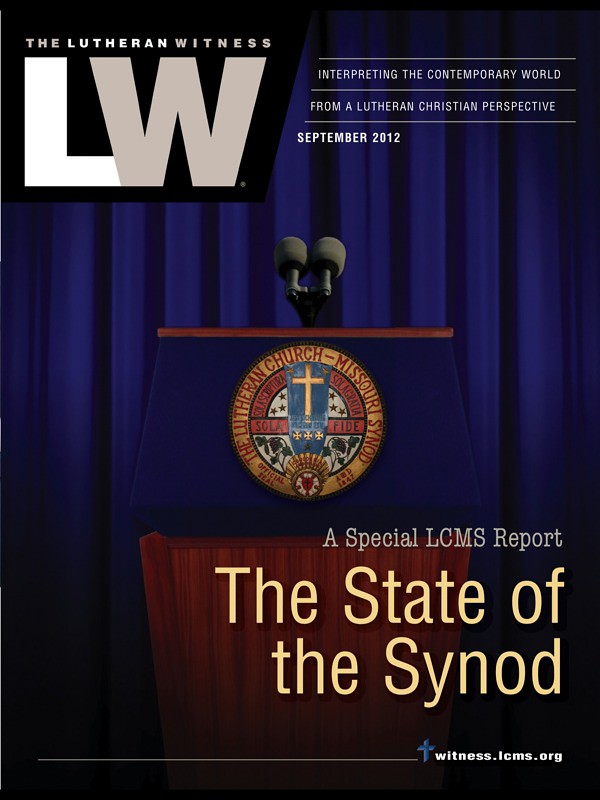
Lutheran Witness on iOS


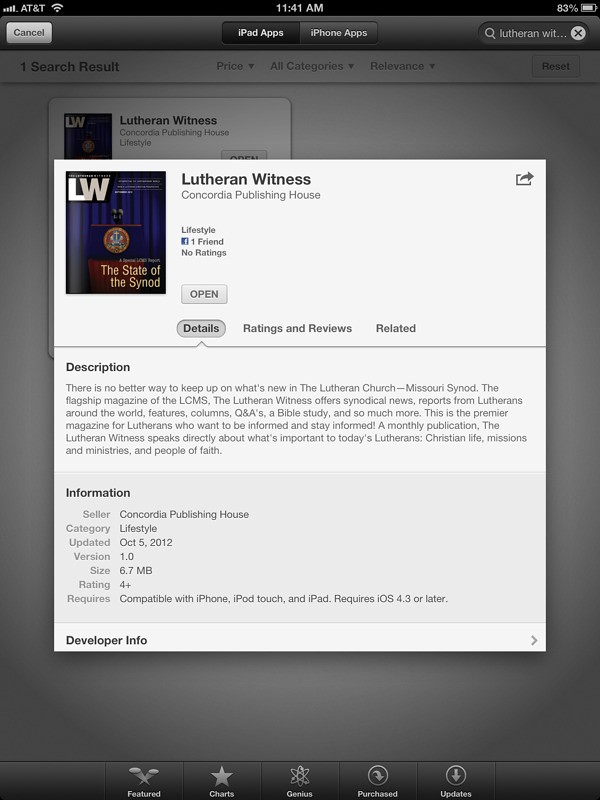
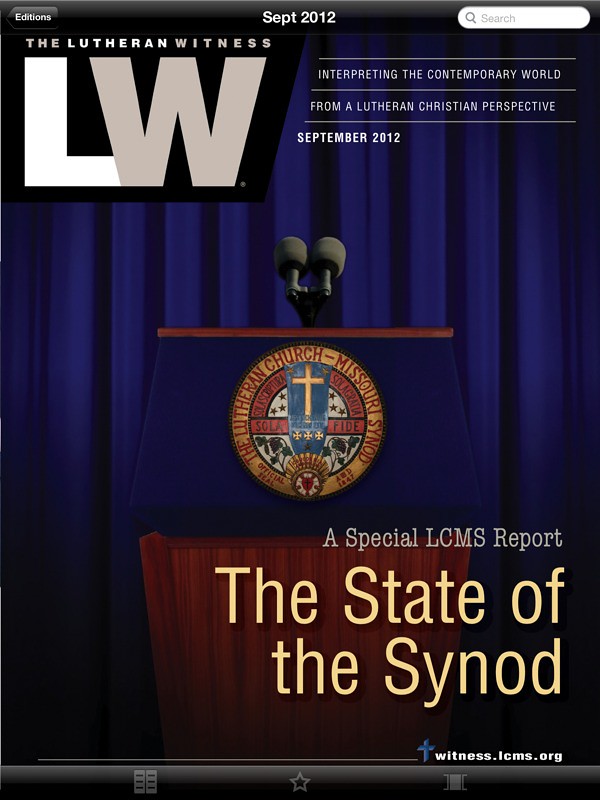
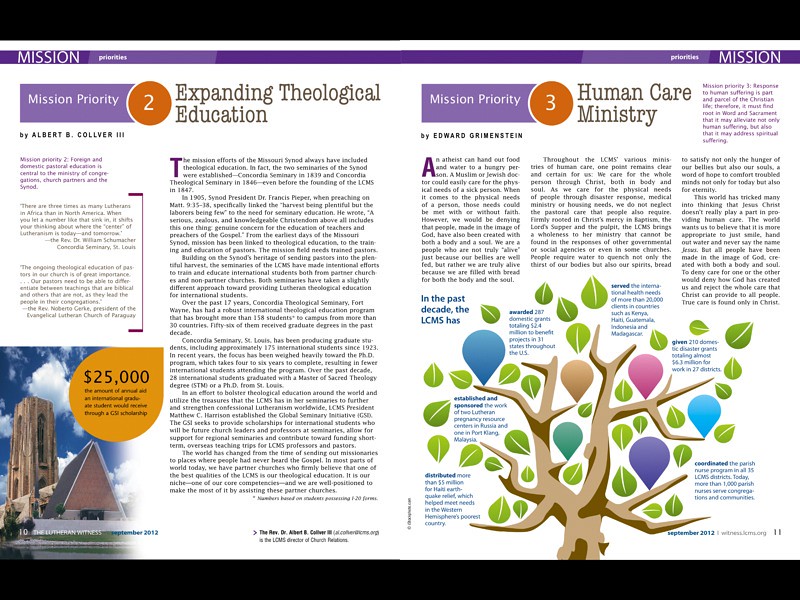
Yesterday, Dr. Bruce Kintz, President and CEO of Concordia Publishing House, sent me a text message to come and meet him. He said bring your iPad. Go to the App Store and search for Lutheran Witness.


In the App Store, the Lutheran Witness app appears and is a free download.


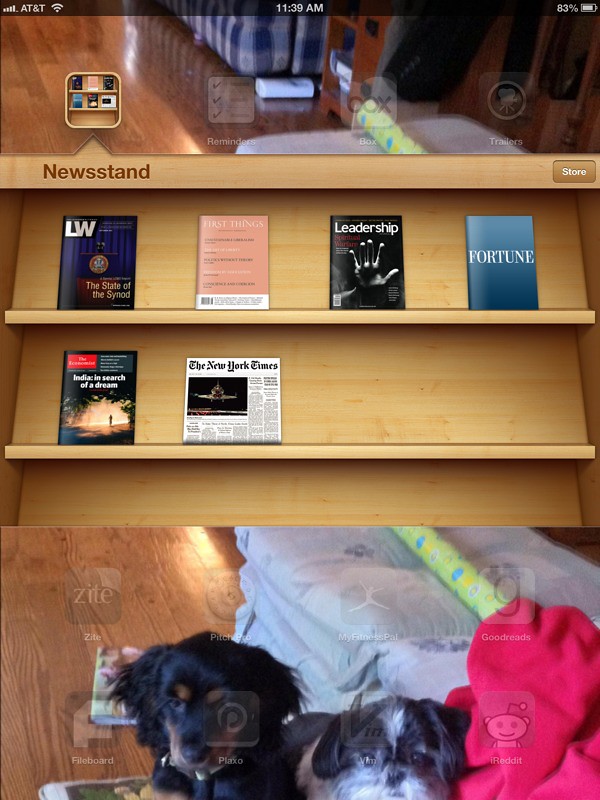
After installation, the Lutheran Witness App appears in the Newsstand.


When the app starts, a person can see the issues he has subscribed to.


Once am issue is selected, the cover of the magazine with a small tool bar offering other views, page book marking, and help.


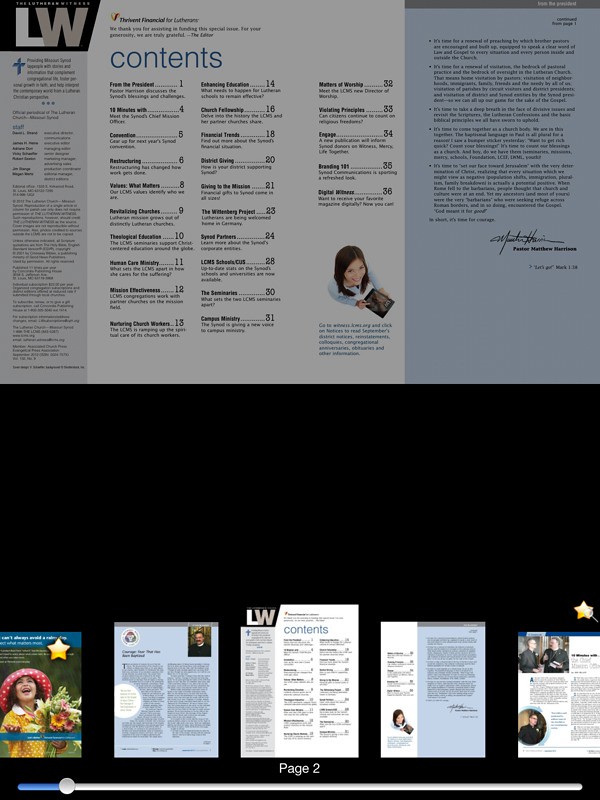
A person can click on an article in the table of contents and immediately jump to the article, or a person can see a thumbnail of individual pages and navigate via the thumbnails.


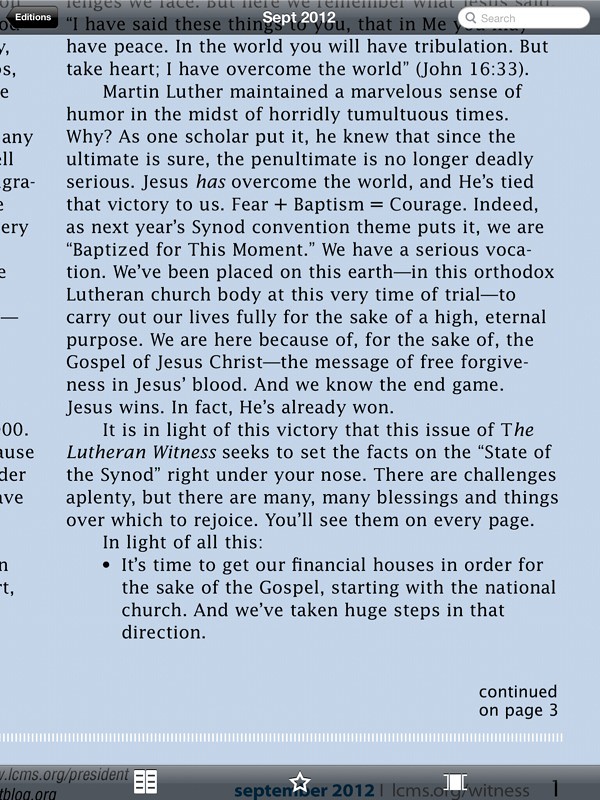
As would be expected, a user can zoom in on text using the iOS, pinch and zoom, feature.


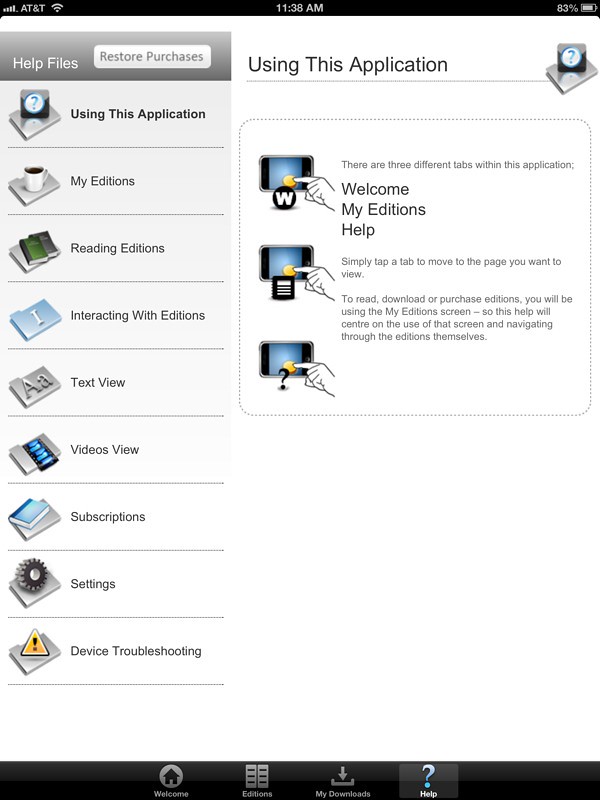
The Lutheran Witness App has a help screen explaining the features.


Rotating he iPad horizontally presents a spread view (2 pages).

The Lutheran Witness App from CPH is a great addition to CPH's electronic resources. I encourage you to go to the App Store and download it for iOS device (iPhone, iPad, iPod Touch) and try it out with the free September 2012 issue of the Lutheran Witness. You can download the app from here.

Visit the CPH website to find out more information about the Lutheran Witness or to order an electronic subscription.

- Posted on 11 October 2012 by Rev. Dr. Albert Collver, LCMS Director of Church Relations

- Posted using BlogPress from my iPad

Location:S Taylor Ave,Kirkwood,United States
Friday, September 7, 2012

Mount Tabor and Around Hawassa


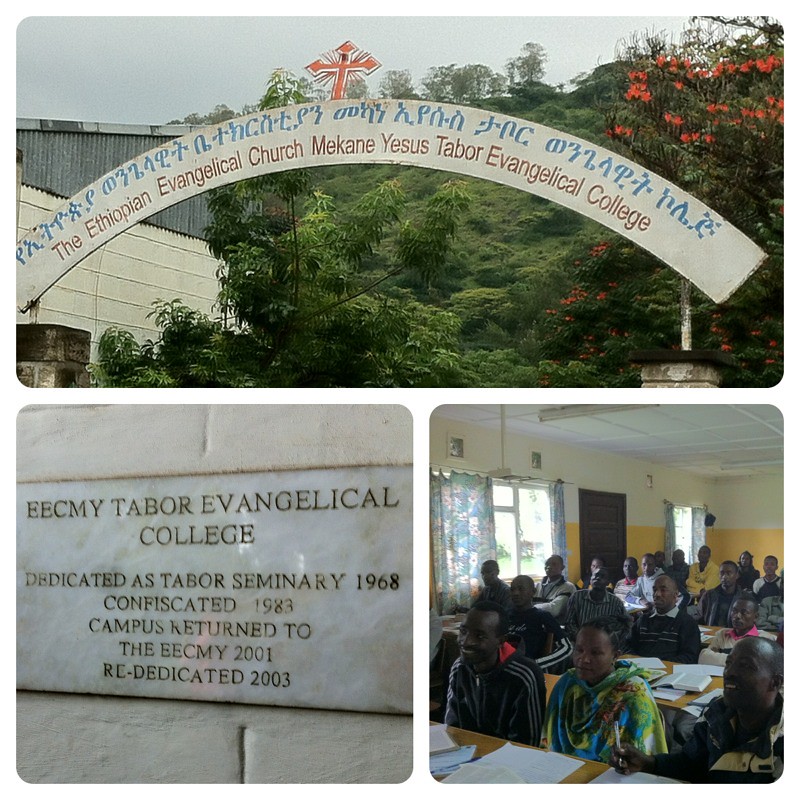
After I chased a monkey out of my hotel room (at first I thought it was a cat), we visited Mount Tabor and then visited congregations around Hawassa, which is a part of the South Central Ethiopian Synod.


The South Central Ethiopian Synod is one of six synods that used to compose the Southern Ethiopian Synod. Approximately, 1.7 million people are a part of these six synods, over 500,000 people are in the South Central Ethiopian Synod. These statistics are important because the Tabor Evangelical College provides the majority of the training for pastors and evangelists in these six synods.

Tabor Evangelical College was formed by the Norwegian Lutheran Mission (NLM) in 1968. About 63 pastors were trained at Tabor between 1968 and 1977. In 1983, the communist Ethiopian Socialist Government confiscated the school's property. In 2001, the government returned then property to the EECMY and the school was reopened as a church operated high school in 2003. Today the high school serves about 700 children. In 2005, a Bible school to train evangelists was opened on the site. In 2008, a certificate / diploma program in Missions was started. Finally, in 2012, a Bachelors in Theology (B.Th) program began.


Of the 3436 congregations in the six synods that comprise southern Ethiopia, there are only 415 pastors. This means each pastor serves on average six to eight congregations. Practically, this means a congregation receives Holy Communion every 6 to 8 weeks. In the EECMY, only pastors can perform sacramental acts such as Holy Baptism and Holy Communion. The evangelists are not ordained and therefore cannot administer the sacrament. In a church body that adds approximately 500 congregations a year and that has a significant shortage of pastors, the EECMY did not "declare" an emergency and allow or license the evangelists or other lay leaders to perform the Sacrament. Instead, the focus and desire is to train more pastors to meet the demand. This is very commendable and shows faithfulness the the Lutheran Confession concerning the office of pastor.


The meager library at Tabor Evangelic College had a copy of Pieper's Christian Dogmatics, Preus' The Fire and the Staff, and Koehler's Christian Doctrine. After a tour of the campus, we departed to see examples of a small, medium, and large congregation -- as well as rural and urban.


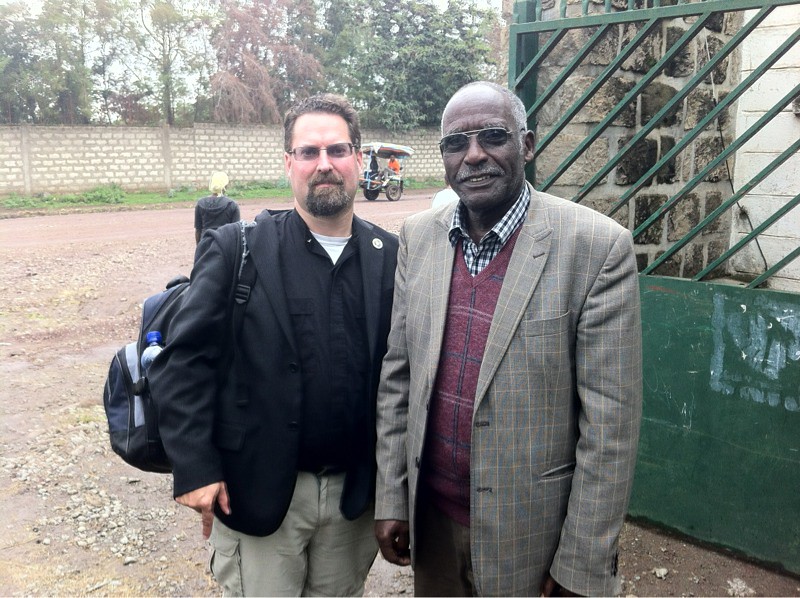
As we left Tabor Evangelical College, we ran into Aklilu Ameje, the father-in-law to Dr. Tilahun Mekonnen, the President of Concordia College, Selma, Alabama. A small world indeed...


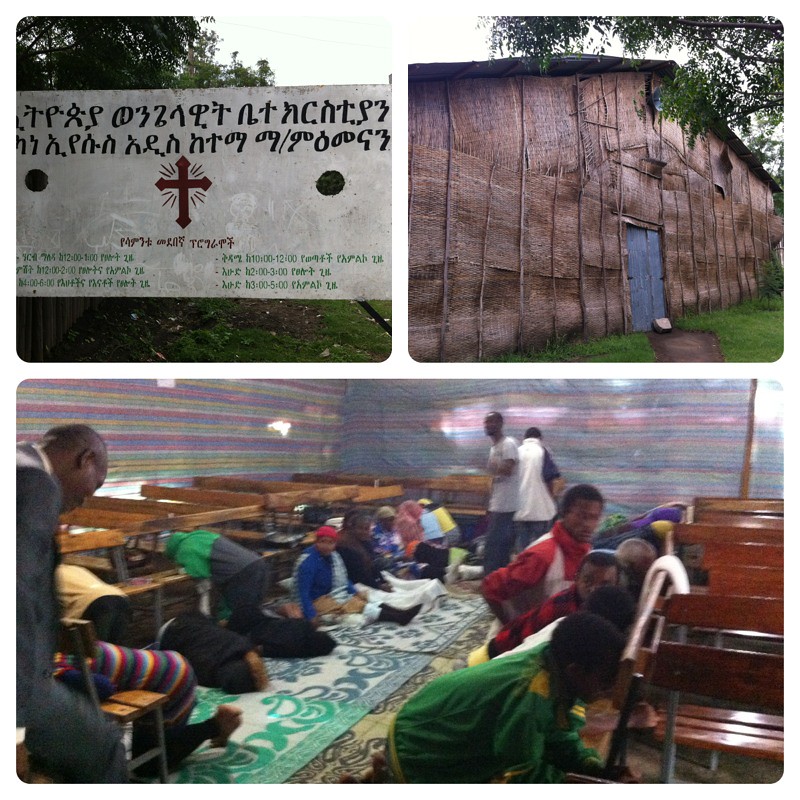
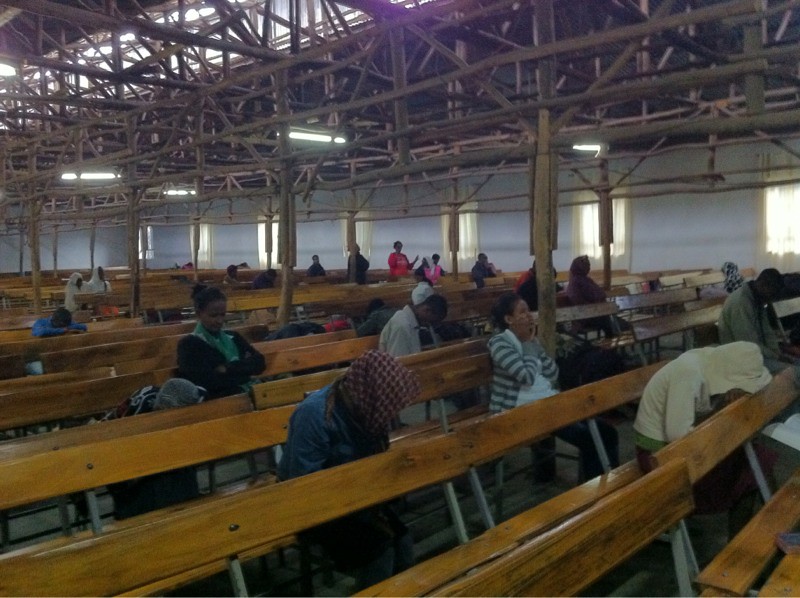
After leaving the college, we visited a small (more than 350 members) congregation in an urban setting. The church is poor in comparison to other congregations... So poor, that concrete or brick walls cannot be afforded. Neither can the congregation afford a pastor. The congregation is served by an evangelist and other lay leaders. When possible, the congregation borrows a nearby pastor to celebrate Holy Communion. When we arrived unannounced, people were gathered in the congregation for prayer. The Ethiopian New Year is approaching. EECMY congregations have the custom of praying the week before the New Year. The synod office gathers prayer requests from across the synod, the country and the world. Each day before the New Year, members of the congregation gather to pray. Every congregation that we visited today held prayer services. Some congregations had 5 people while others had 100 or more.


At a larger congregation, people gather for prayer before the New Year.


Next we visited Tabor Congregation, which only can be described as a "mega" church with over 6,500 members. Tabor Congregation started just 16 years ago with 250 members from the mother church in Hawassa. This congregation sends evangelists through out southern Ethiopia. We asked the congregation leaders and the Synod President if there was ever conflict between the evangelists sent by Tabor Congregation and other congregations or the synod. Both answered no. They told us that the work was done "systematically"'and in coordination with the Synod's strategic plan. After the evangelists start a congregation, they turn it over to the Synod.


We visited the Ambosa Congregation outside of the city. This congregation would represent a rural, middle class church. The congregation has about 600 communicant members, and about 1100 total members (500 unconfirmed children). Notice the building style is similar to the church's built by the Norwegians. Similar style churches can be found in Madagascar, where the NLM also was active.


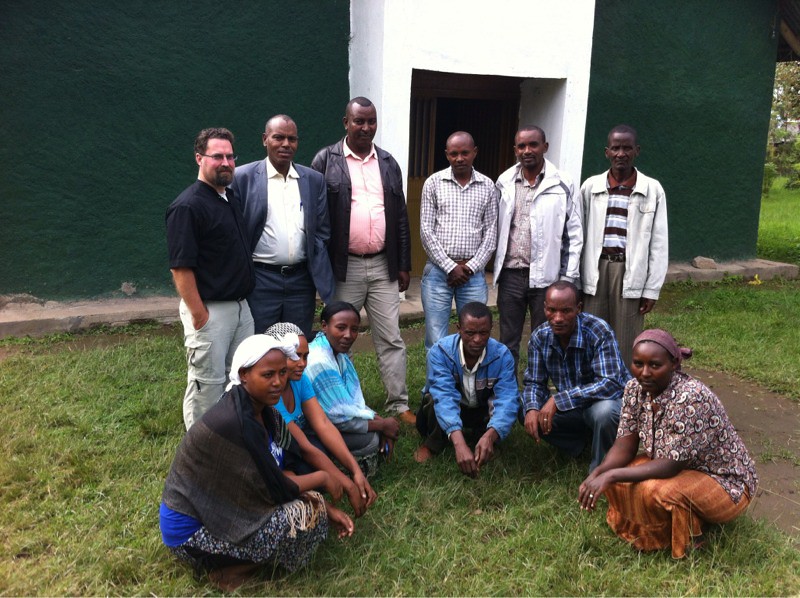
All the congregations we visited were very hospitable. While we saw only a fraction if the 1,100 or so congregations in the South Central Ethiopian Synod, we have an overview of small, medium, and large congregations in both rural and urban environments. We also saw the tremendous need to train more pastors, as well as the resilience of God's people.


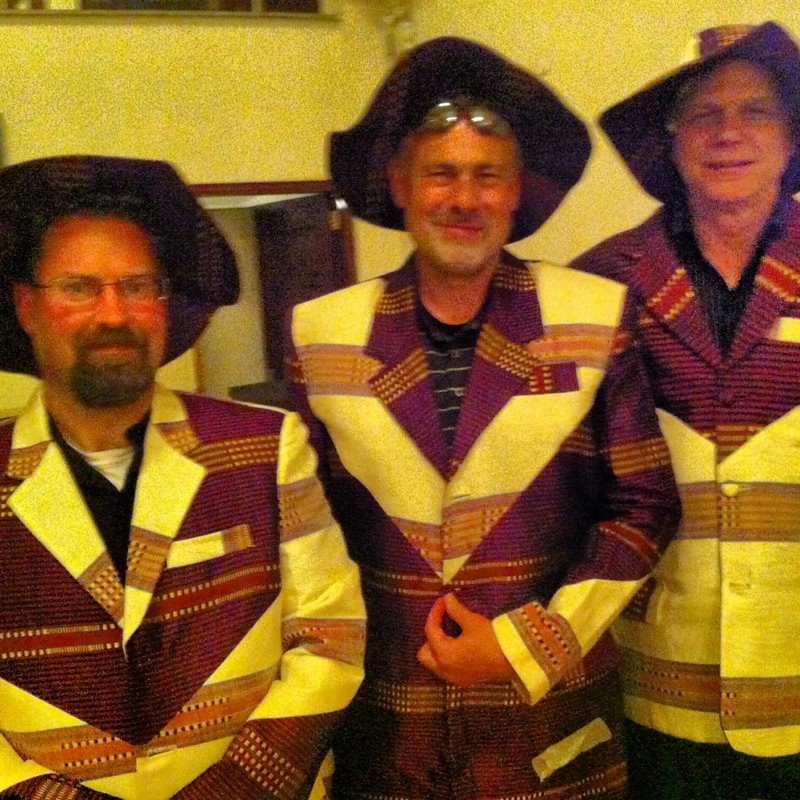
As we bid farewell to our hosts this past evening, we were given a gift of traditional Sidamo clothing. Thank you President Hailu Yohannes Bullka, and all the pastors, evangelists, church leaders and people of the South Central Ethiopian Synod, who showed us wonderful hospitality.

We leave Hawassa in a few hours to return to Addis Ababa so we can catch our return flight.

- Posted on 8 September 2012 by Rev. Dr. Albert Collver, LCMS Director of Church Relations.
- Posted using BlogPress from my iPad

Location:Awasa,Hawassa,Ethiopia

To Awasa


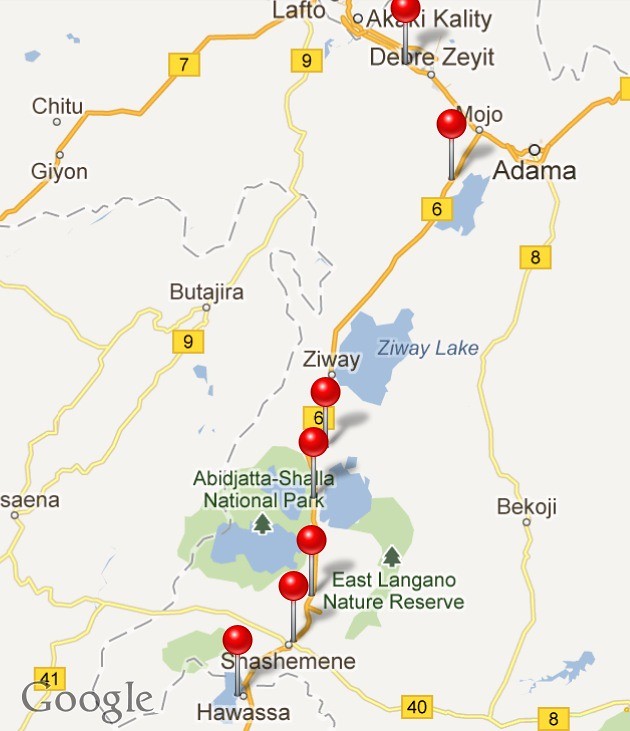
Yesterday, we rose early and drove south from Addis Ababa to Hawassa. Along the way, we stopped at various places.


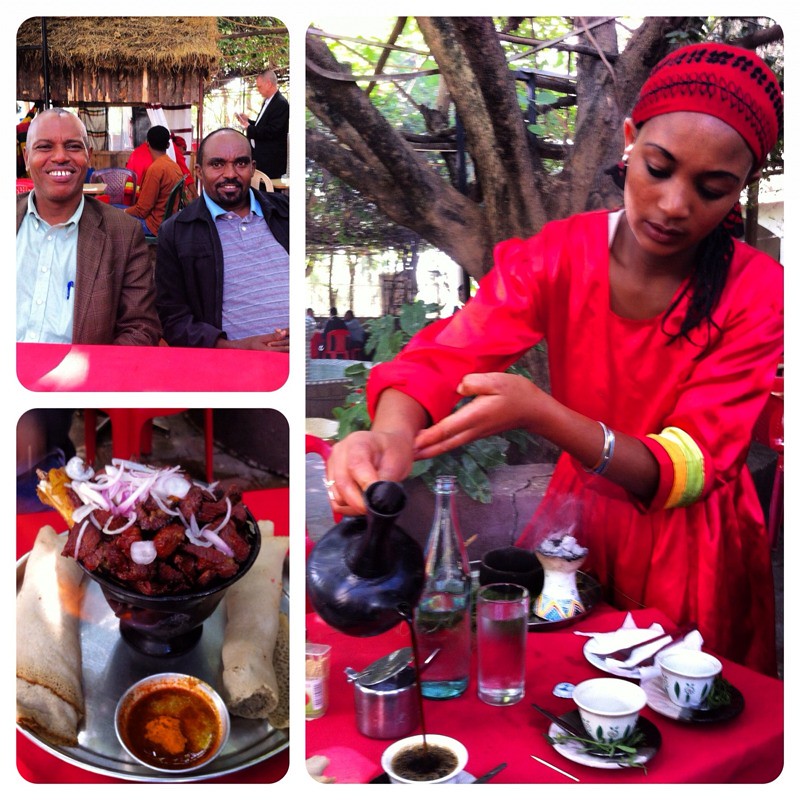
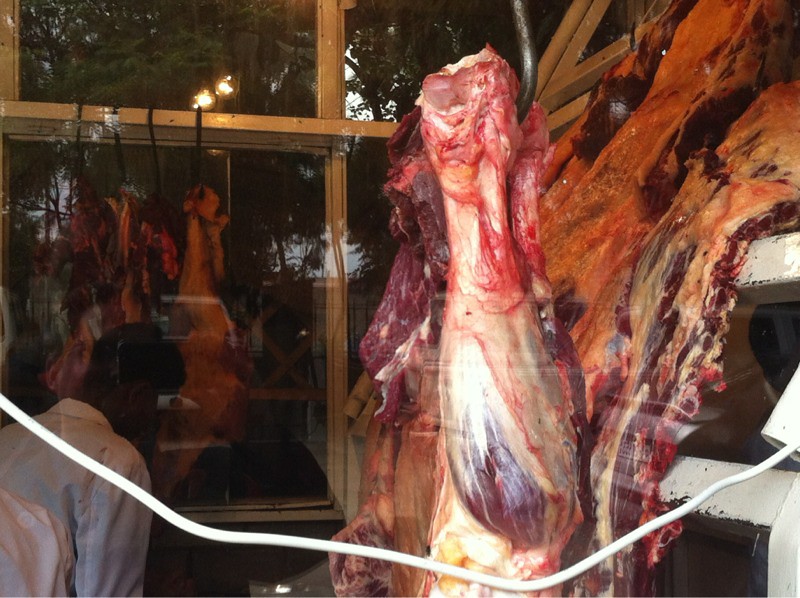
After leaving Addis Ababa at dawn, we stopped for breakfast at a traditional Ethiopian restaurant in Ziway. This restaurant featured the delicacy of raw meat, which we avoided. We did take part in other traditional Ethiopian food such as tibs and the traditional coffee ceremony.


Raw meat being prepared to be serve to restaurant guests.


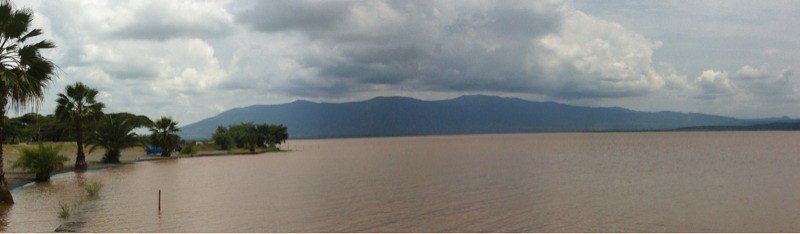
We stopped at Langano Lake for lunch and coffee. There are many lakes along the rift valley. The lake above is known for its brown water and for not being infested with parasites.


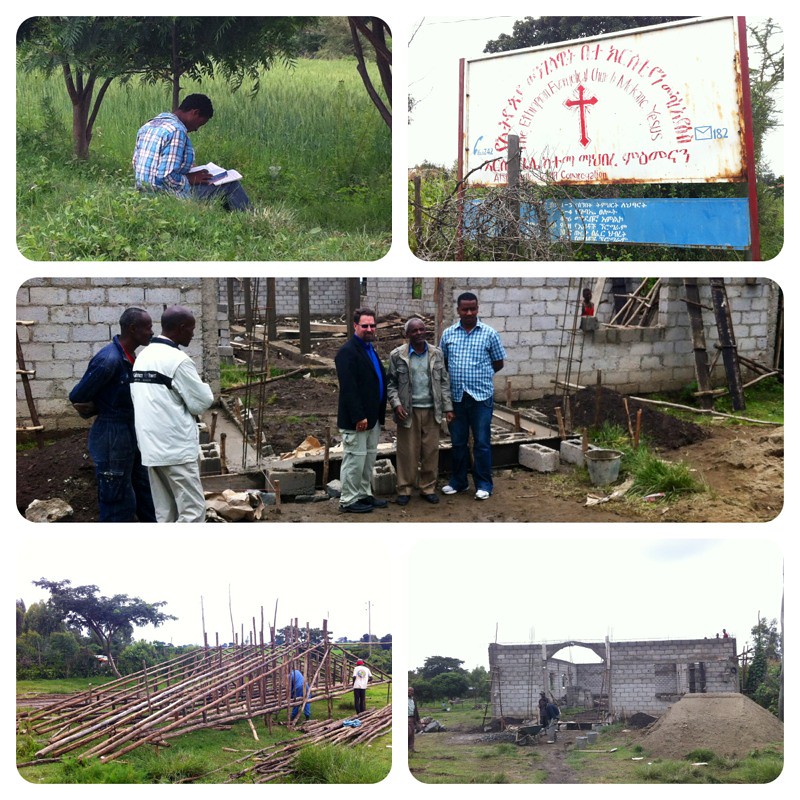
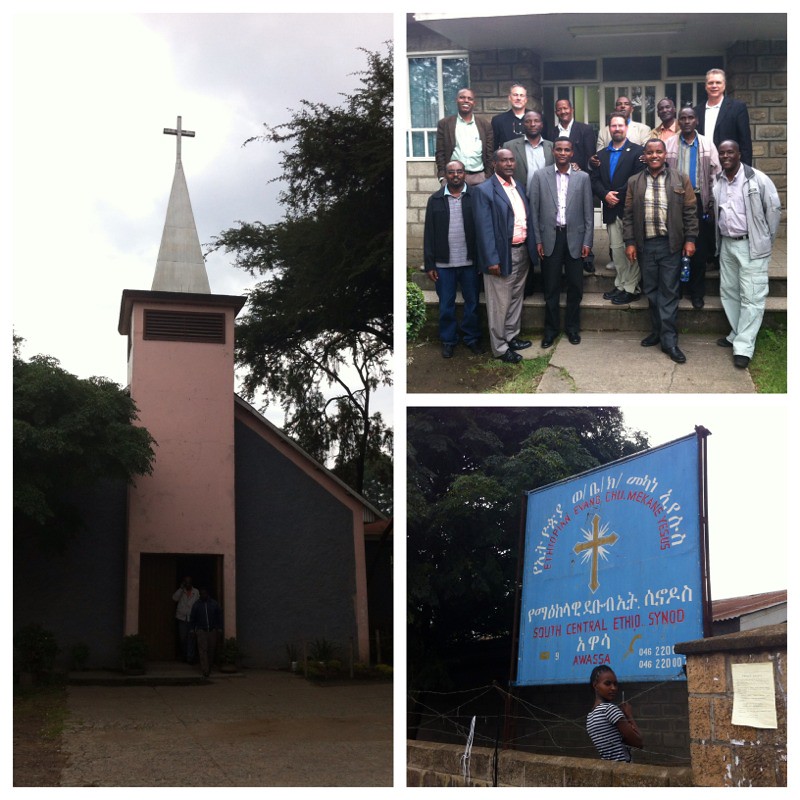
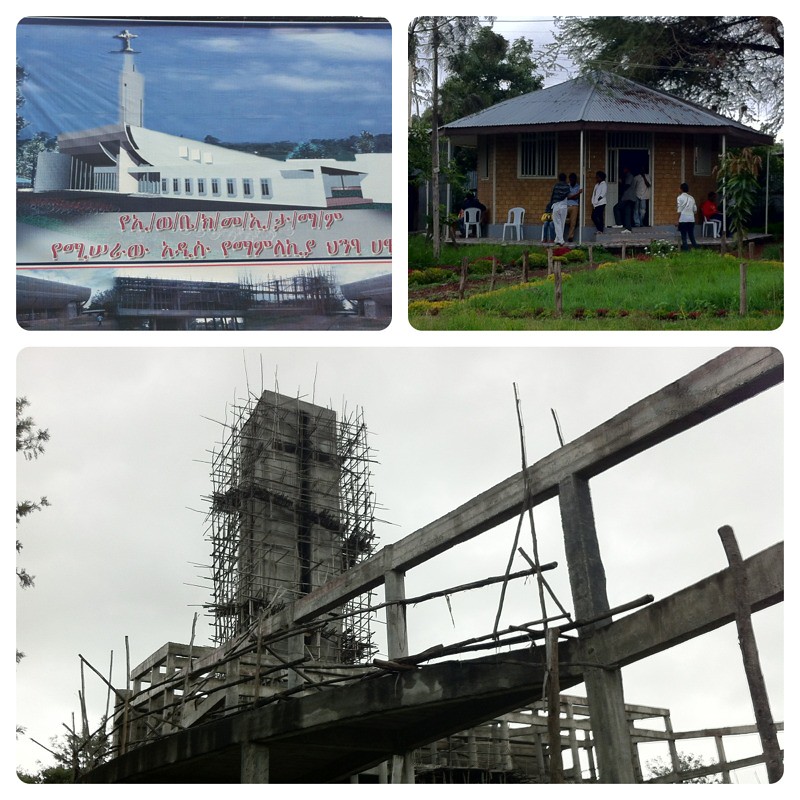
Before reaching the Awassa, we visited the Arsii-Negle congregation of the Central Rift Valley Parish. This congregation is rapidly growing in a Muslim area. Currently, there are about 500 members. After last Sunday's service, the congregation tore down their old building and began construction on a new building to better accommodate the people. Next to this congregation is a missionary training center that was initially funded by the LCMS. The LCMS has in the past assisted congregations such as the Arsii-Negle congregation with tin roofs to complete the construction.


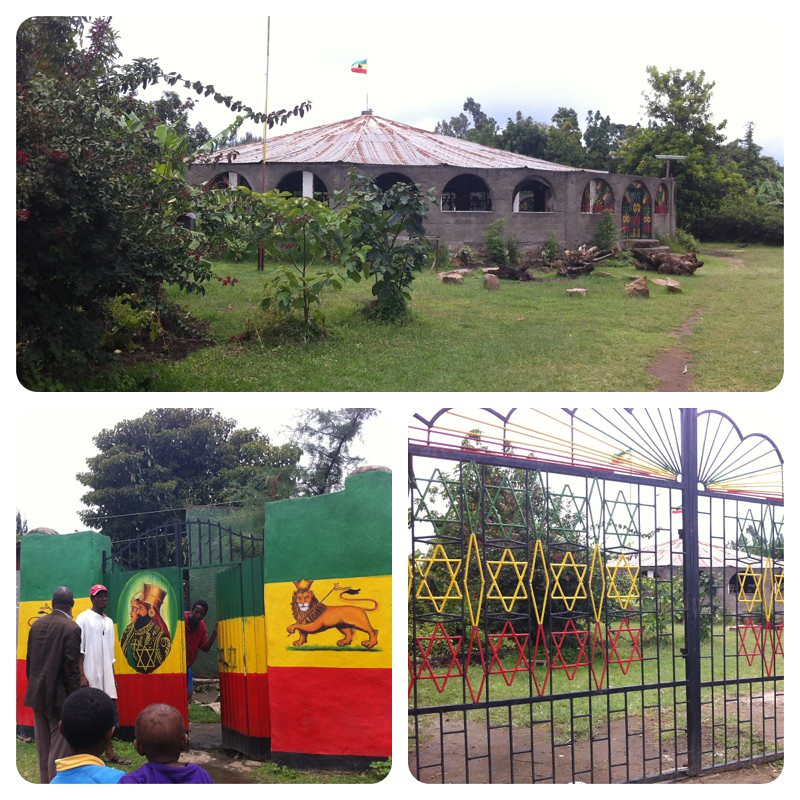
As we drive closer to Awassa, President Hailu mentioned to us that we were entering a Rastafarian area. He said do yo want to see the temple? We said sure and stopped to see the Rastafarian Temple in Shashemane, Ethiopia. Many people from Jamaica have come to Zion (Shashemane, Ethiopia).


Finally we arrived at the headquarters of the South Central Ethiopian Synod. In the SCES, there are more than 500,000 members, 1310 congregations, and 140 pastors. One of the greatest needs is for the training of new pastors. Today, we will visit Mount Tabor Regional Seminary to better understand the training needs of the SCES.


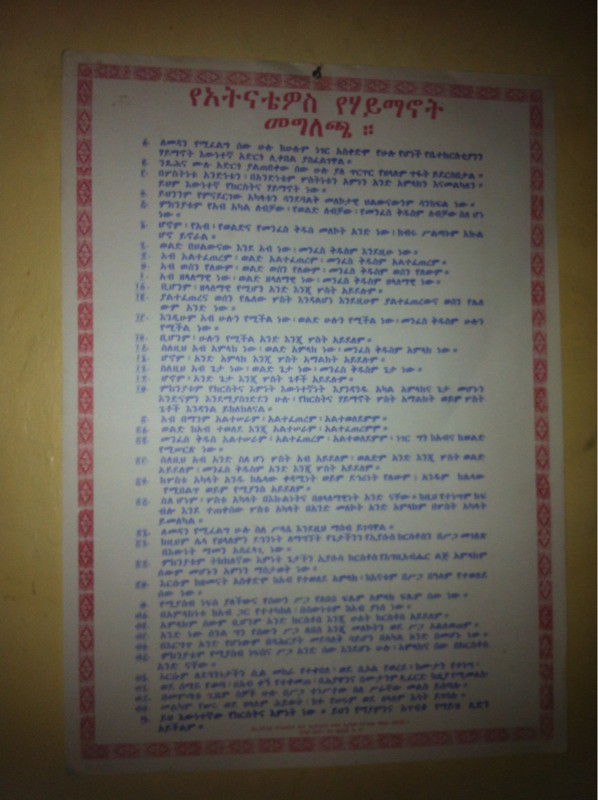
The Athanasian Creed is posted in several places in the South Center Ethiopian Synod's headquarters.


A page from the EECMY hymnal. This is the beginning of Sunday worship and is very similar to what the LCMS uses.


Teaching the next generation how to use an iPhone.

Our time here has been good and we have been received well.

- Posted on 7 September 2012 by Rev Dr Albert Collver.
- Posted using BlogPress from my iPad

Location:Awasa,Hawassa,Ethiopia

Wednesday, September 5, 2012

Trip to Ambo


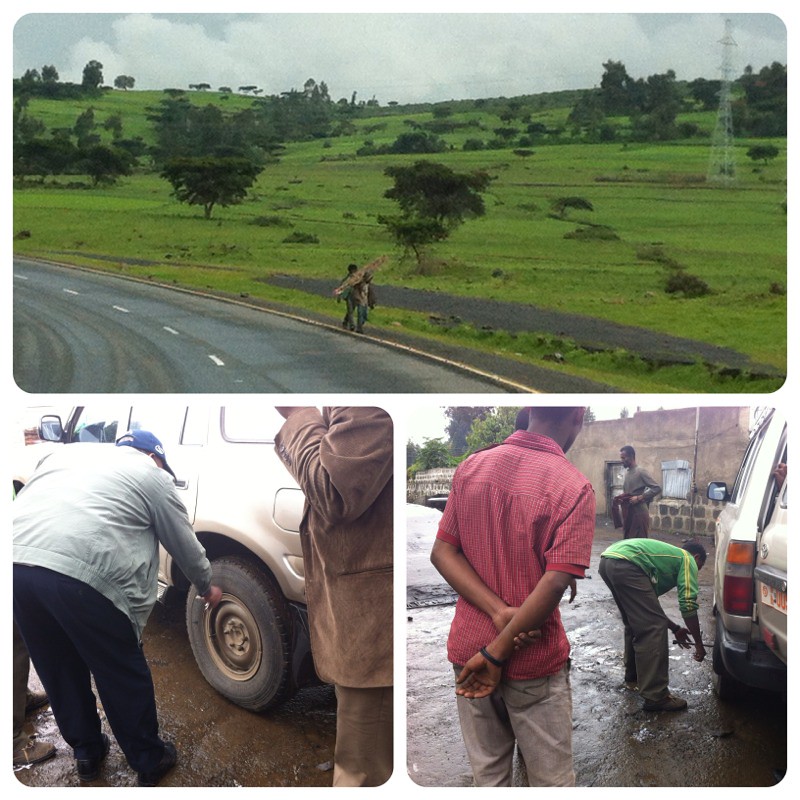
This morning we left Addis Ababa for Ambo in the second hour of the morning (8 AM). In Ethiopia, time is reckoned much like the Bible -- twelve hours of night and twelve hours of day. The sun rises at 6 am. The third hour of the morning is 9 am. Shortly after departing from Addis Ababa, our rear tire went flat.


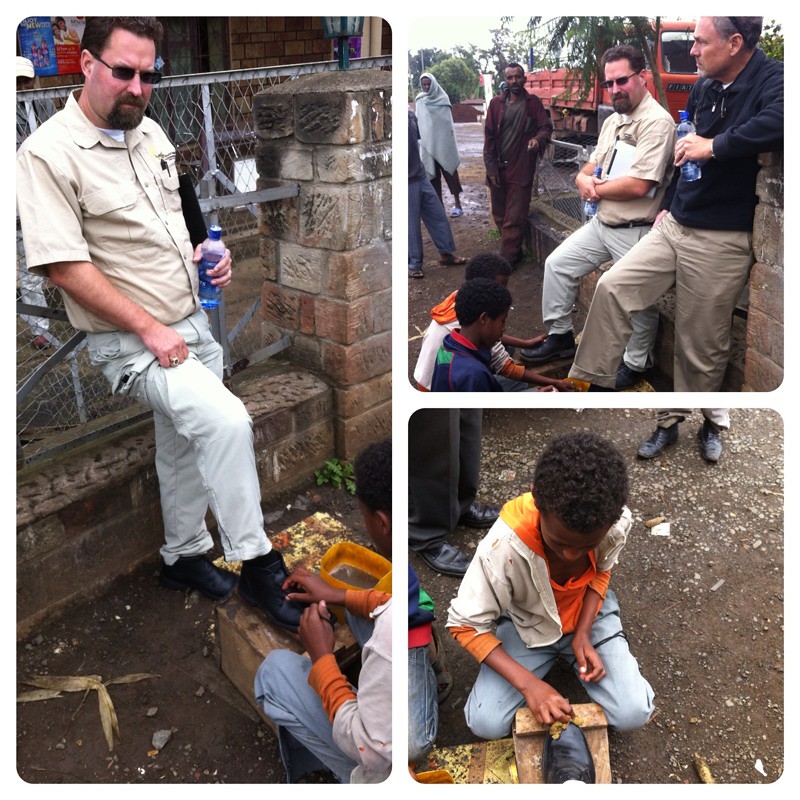
While waiting for the tire to be replaced, Drs. Collver and Lehenbauer had their shoes shined after President Abraham first had his shoes shined. The cost of each shoe shine was equivalent to about 15 cents in US currency. As meager as that sounds, the boys were thrilled to shine our shoes and to receive our wages. In fact, our Ethiopian hosts would not allow us to over pay the boys. So we paid the going rate.


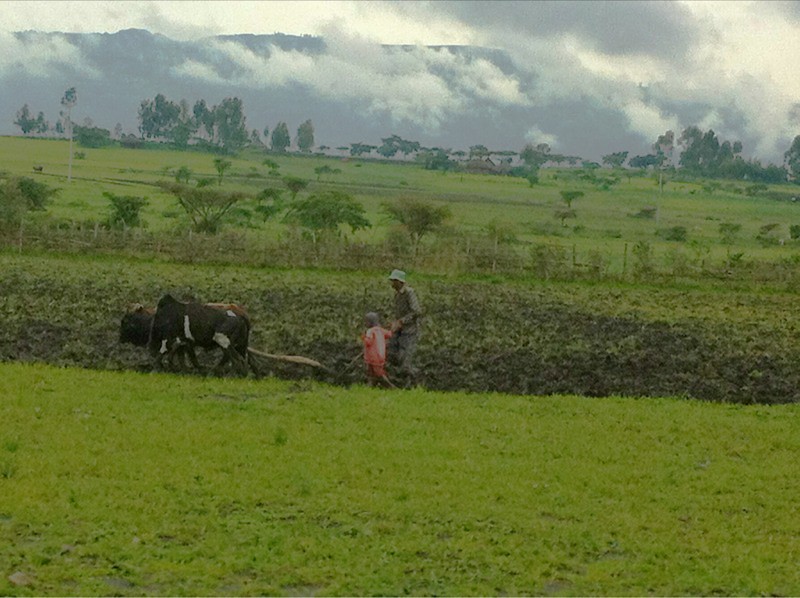
The land between Addis Ababa and Ambo is primarily farm land. The land is farmed in the traditional way with ox drawn plows. Today was the day to plow as many, many farmers were plowing their fields.


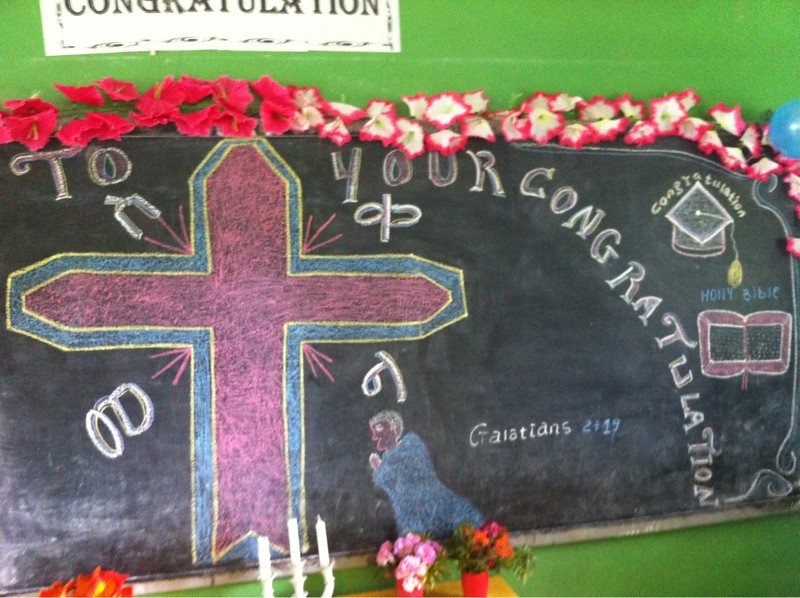
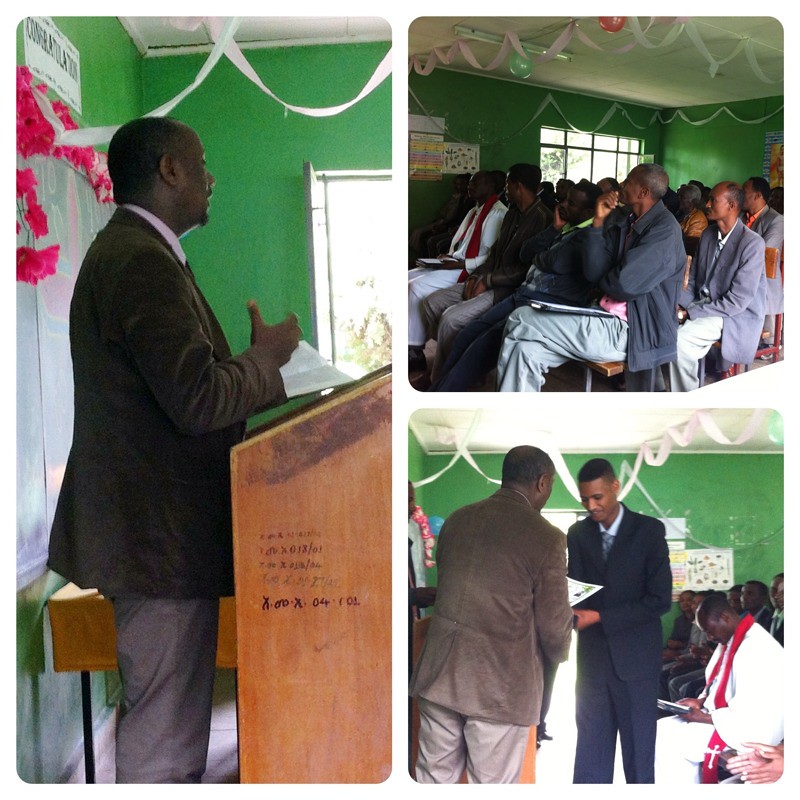
When we arrived in Ambo, we attended the graduation ceremony for seven evangelists.


President Abraham of the Central Ethiopian Synod (EECMY) spoke to the graduating class and passed out the certificates. Twenty-three other students are half way through the two year, summer intensive program. An evangelist has the responsibility to preach to the non-believers near their assigned congregation, to visit congregation members, and to teach the catechism. They cannot celebrate the Lord's Supper, as that is reserved for the ordained pastors in the EECMY. Female evangelists have a very similar role to deaconesses in the LCMS -- teaching Sunday school, visiting the sick, and teaching adults.


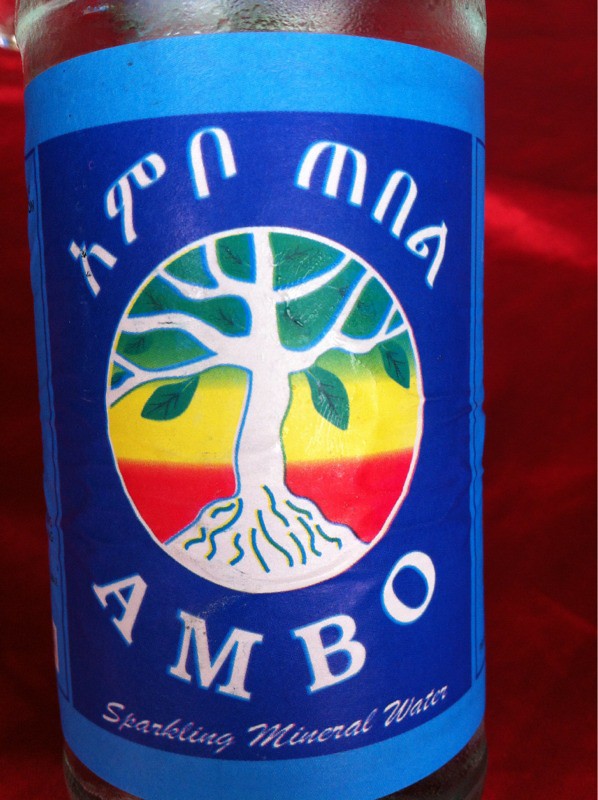
We ate lunch in Ambo, which is famous for its natural, sparkling mineral water. Over lunch we had a fascinating conversation regarding communion practice, casuistry items such as how to handle divorce in a congregation and when remarriage is permitted, and fellowship issues. President Abraham explained how during the communists years non-Lutheran protestants such as Presbyterians, Baptists, and Pentecostals merged into the EECMY as a fellowship union. This was a pragmatic move during the communist years, not unlike other Protestant groups calling themselves Lutheran during the Reformation. President Abraham explained how the EECMY recently broke this fellowship union with the other Protestants because they did not hold Lutheran doctrine. He also explained that only Lutherans commune at Lutheran altars. He said in fact the Baptists and Pentecostals consider the EECMY too close to the Orthodox and the Roman Catholics because the Lutherans believe that in Holy Communion Christ gives his body and blood to eat and to drink. The conversation was very helpful. After lunch we visited some congregations in the Ambo region.


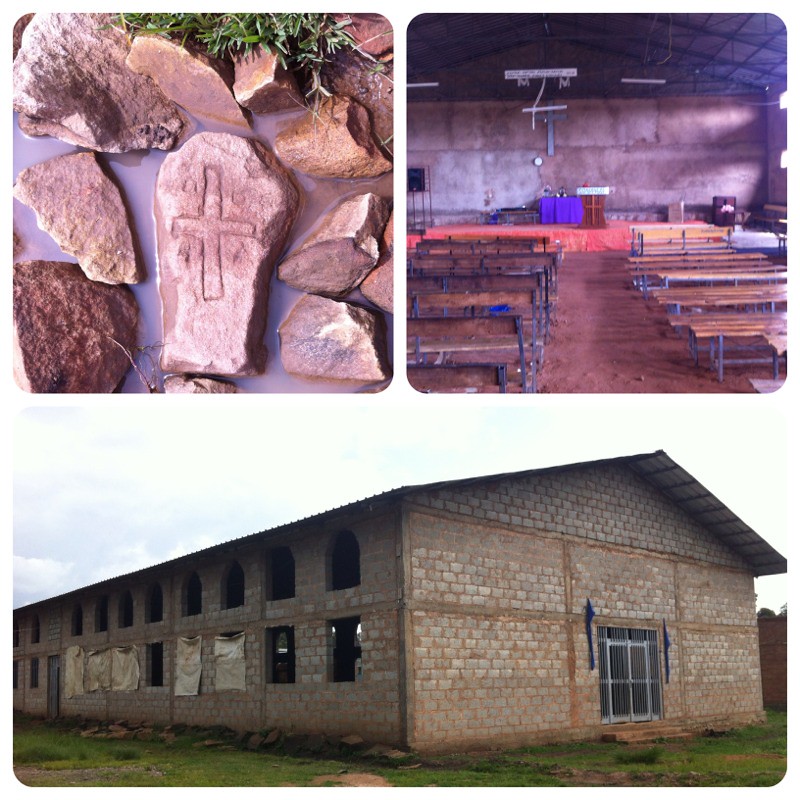
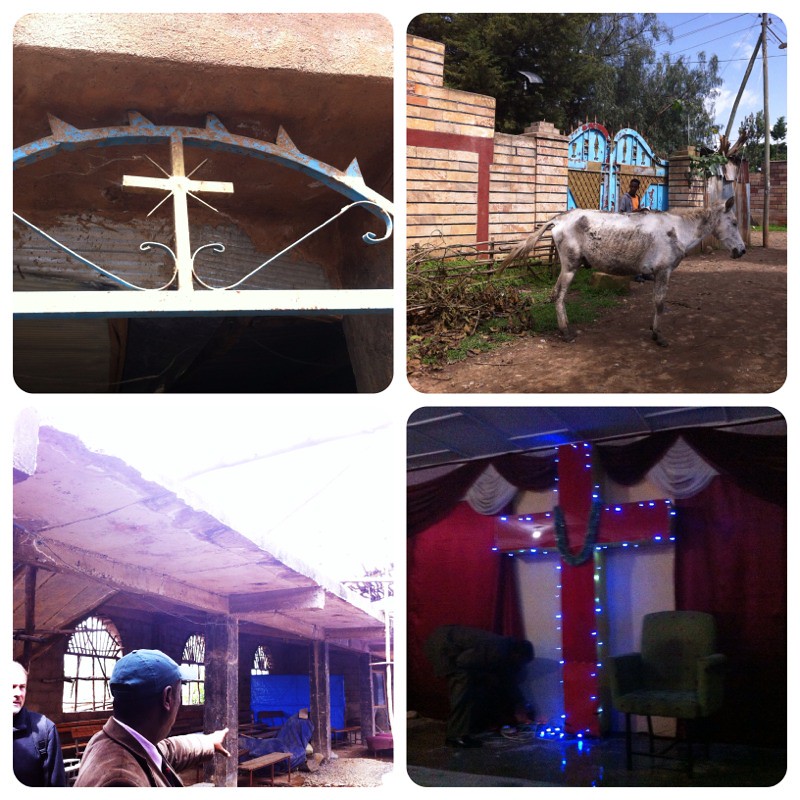
The Ambo Parish has 32 congregations and 12 preaching stations. It is one of the fastest growing areas inside the EECMY. In fact, it seems that the church buildings cannot keep up with the number of people attending church on a Sunday. The congregation pictured above is 4 years old and has 1,300 communicant members with 1,800 members total. Last year, the congregation added 357 members.


The congregation pictured above in the Ambo Parish has a regular Sunday attendance of 4,000 people. The pastor explained that they are adding a second story to the building to accommodate more people. This congregation is near a university and has an active outreach to college students.


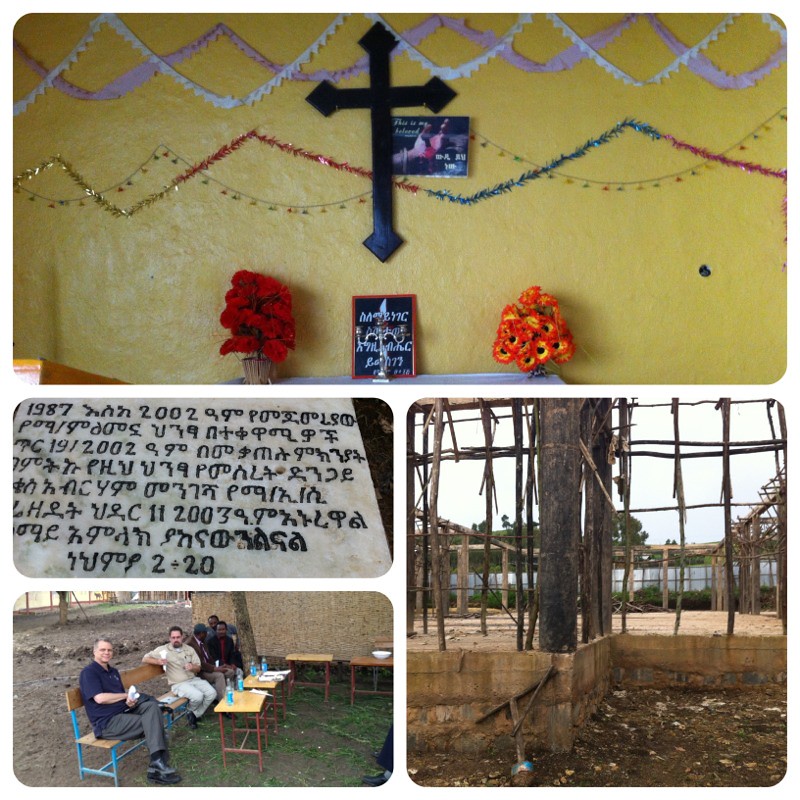
The final congregation that we visited Olo Nkomi was burned down in 2009 (the commemorative marker says 2002 because the Julian Calendar is 7 years behind the Gregorian calendar used in the West) by Ethiopian Orthodox zealots. The evangelist at this parish was stoned by the zeolites. Although he survived the attack, he has been permanently damaged. President Abraham explained that several EECMY congregations have been burned to the ground by Orthodox and Islamic radicals in recent years. He noted that the persecution has actually caused more people to flock to the EECMY... As Tertullian wrote in the 2nd century, "The blood of the martyrs is the seed of the church."


After we visited the EECMY congregation that had been burned down, we visited the nearby Ethiopian Orthodox monastery.


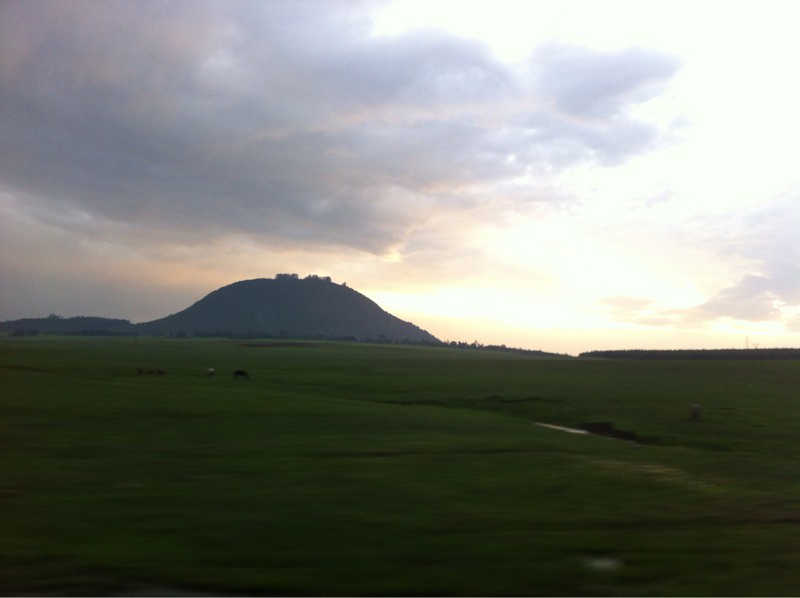
A Ethiopian Orthodox Monastery sits on top of the small mountain pictured above. We returned to our hotel after dark to prepare for an early departure at sunrise to the southern part of Ethiopia.

- Posted on 5 September 2012 by Rev. Dr. Albert Collver, LCMS Director of Church Relations.

- Posted using BlogPress from my iPad

Location:Dejazmach Belay Zeleke St,,Ethiopia