Search This Blog

Wednesday, September 1, 2010

Moving In, First Day, and Commemoration of Joshua

Crucifix in President Harrison's Office at International Center

Lord Jesus, my salvation,
My light, my life divine,
My only consolation, 
O make me wholly Thine!
For Thou hast dearly bought me
With blood and bitter pain.
Let me, since Thou hast sought me,
Eternal life obtain.

-- Let Me Be Thine Forever (LSB 689:2)
Hymn appointed for Commemoration of Joshua in 
Treasury of Daily Prayer

 Today marked the Commemoration of Joshua in the Lutheran Service Book lectionary and the matriculation of President Matthew Harrison, 1st Vice President Herbert Mueller, Rev. Jon Vieker, Mrs. Barbara Below, and Rev. Dr. Albert Collver into their new offices at the International Center.  For those interested, I have provided some photos of us moving into our offices.


Chapel Schedule at the International Center
August 30 - September 3, 2010

This photo shows the chapel schedule at the International Center in Saint Louis for the week of August 30th. The sign captures a moment of transition within The Lutheran Church—Missouri Synod. Despite the sign, President Harrison did not preach on 1 September 2010. When the sign was made it wasn't realized that President Harrison and 1st Vice President Herb Mueller had a meeting with members of the Council of Presidents. As a result, I actually had the privilege and opportunity to preach in chapel for the Commemoration of Joshua and on the first day of President Harrison's term. Pastor Vieker played the organ. The order of service was Matins; the text Joshua 24:14 - 28. The hymn was LSB 689, "Let Me Be Thine Forever." The sermon focused on Ebed Yahweh, "the servant of the Lord," Jesus who came to serve us. Because He has served us through his death and resurrection, we receive his forgiving gifts which spill out onto our neighbor. Jesus is our Joshua who led us through the waters of baptism into eternal life.

President Harrison hauling books into his office in the afternoon

President Harrison with a few more books

Note all the books with covers of velum. President Harrison has quite a collection of books from the 16th and 17th century. I have three or four volumes from the 16th and 17th century -- two of them are by Philip Jakob Spener (at least they were owned by Piepkorn). A few hours later, the back wall had book shelves full of Luther's works. President Harrison is one of the few men I know who owns a Weimar Edition of Luther's Works (Weimarer Ausgabe -- WA, if not familiar read about it in Wikipedia). On the "Luther" wall, President Harrison also has the American Edition of Luther's Works published by CPH and Augsburg-Fortress, The "Saint Louis Edition" -- Walch 2, and the Walch edition. In 1st Vice President Herb Mueller's office you find the Saint Louis Edition and the American Edition of Luther's Works... (Rev. Vieker also has the same set as 1st VP Herb Mueller)... I have these at home... President Harrison reads Luther's original languages (German and Latin) the best among us. 

1st Vice President Herb Mueller

You can't see Pastor Mueller's bookcase here, but it is also full of Luther.

Mrs. Barbara Below in her office

Rev. Jon Vieker in his office


President Harrison (in the back), Mrs. Barb Below, Pastor Jon Vieker
(Note this photo taken on my iPhone -- I think it looks the best)

abc3+ at his desk

Hope you have enjoyed the tour of the offices and seeing us starting to move in.


Saturday, August 28, 2010

Marriage by God's Design -- CPH Video Bible Study


Check out the trailer for Marriage by God's Design, a CPH Bible study edited by Robert Baker and features among others President-elect Harrison and his wife Kathy. Take a look.

abc3+
--

What does the Bible teach about marriage?

Today, there are a lot of conflicting ideas about what marriage is and isn't. Love. Adoption. Engagement. Children. Divorce. Wedding. Civil union. Single living. Widowhood. Separation. Chastity. Until death do us part. What does it all mean? Are there any concrete answers, or is it all just opinion?

Thankfully, God has given us the reliable guide to help us navigate through the confusion: His Holy Word. "Marriage by God's Design" is a unique resource that mines the riches of Bible texts speaking to God's holy institution of marriage. Through thought-provoking questions and explanations of Greek and Hebrew terms, participants will explore, learn, and grow in their appreciation of Christian marriage. Video vignettes of real couples and singles will foster meaningful and fruitful discussions about the challenges and joys of married—and single—living.

Because it is based on Scripture, "Marriage by God's Design" is a perfect resource for small group study, marriage renewal or retreats, and premarital counseling in your congregation.

Thursday, August 26, 2010

President-Elect Harrison's Transition Team

Barb Below, Kim Vieker, abc3+, Jon Vieker

For those of you who are wondering what the staff of President-elect Harrison have been doing since the election in July, we have been working together on the transition in room 460 of the International Center. Dr. Timothy Quill happened to be in the International Center related to his work with Rev. Glenn Merritt in Haiti suggested that the team be photographed working. Rev. Glenn Merritt snapped this picture. 

Tuesday, August 24, 2010

adiaphora -- In the Way of the Law or In the Way of the Gospel

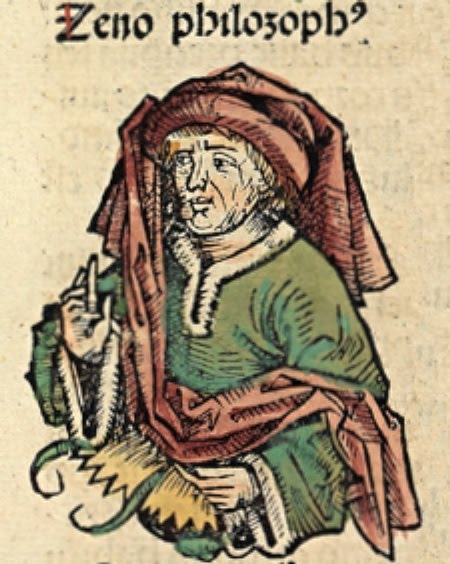
Zeno from the Nuremburg Chronicle,
Published by 
Anton Koberger, the godfather of Albrecht Dürer

Last night I was reading The Fragments of Zeno and Cleanthes while tracking down the phrase κατὰ φύσιν (kata physin -- "according to nature") for a study about natural law. The antonym of is παρὰ φύσιν (para physin -- "against nature").  Saint Paul uses the phrase in Romans 11:21, "the natural branches" -- (εἰ γὰρ ὁ θεὸς τῶν κατὰ φύσιν κλάδων οὐκ ἐφείσατο, οὐδὲ σοῦ φείσεται.) The phrase seems to have originated in Stoic philosophy but was appropriated by the church.

Athanasius uses the phrase when discussing the two natures of Christ. Martin Chemnitz uses the phrase in The Two Natures of Christ. He writes, "So let us believe Scripture when it speaks of Christ’s human nature, both as to the things which are according to nature (κατὰ φύσιν) and the things which are above nature (ὑπὲρ φύσιν) and even contrary to nature (παρὰ φύσιν). And let us agree that the Son of God wills and can be present with His body where we have His express word."  (pg. 438) 

All of this comes as way of background to the point of the post. The phrase "according to nature (κατὰ φύσιν)" is used as a term for "natural law," that is, something that is according to the created order. Everything "good" and "worthy" is according to nature.  Likewise, if it is against nature, then it is bad.

Zeno has another category of ἀδιάφορα "indifferent things."Adiaphora are things in between what is "according to nature" and "against nature." It is important to note that what is adiaphora cannot be "against nature." 

Leaping ahead to adiaphora in Lutheran theology. Usually, adiaphora is described as "something that is neither commanded nor forbidden." This is a Law or legal sort of definition. A Gospel way of describing adiaphora might be "something that is according to the nature of the Gospel," or even "something that is not against the nature of the Gospel." Adiaphora described in terms of the Gospel was something Dr. Norman Nagel was trying to teach me years ago -- perhaps it is coming clear.

Now some of you might be thinking of Augsburg Confession VII and the satis est in regards to adiaphora.  To fully get the point of the confessors, you need to read the Augsburg Confession in both Latin and German. In Latin, you get satis est ... it is enough, a minimal definition. In German you get einträchtiglich ... "with one accord," a maximal definition, that is, running adiaphora "according to the Gospel."

Some preliminary thoughts... more later.
__
abc3+

Wednesday, August 18, 2010

Same-Sex Marriage Debate -- Blame It on Love?


A recent article (posted below) suggests that the same-sex marriage debate has it origins in changes in marriage going back centuries. The article claims a change in attitudes about marriage in the late 1700s led to current debates about marriage. The change? that couples should marry for love. The article argues that before the late 1700s marriage was more about the community and less about the individual. Once couples determined that they should be "in love" with one another, the institution of marriage changed. The article argues despite the "change" in marriage, it survived. The clear implication is the institution of marriage will survive the change of "same-sex" marriage, too.

The article questions the definition of "traditional" marriage, providing various pagan practices as examples of "marriage." It identifies the "Western" ideal of marriage of one man, one woman for life as originating in the church. This "Western" ideal of marriage is merely one of many options in the history of the world. Martin Luther notes, "The marriage of man and woman was divinely ordained." (Genesis Lectures, AE 1, 142).

In summary, according to the article below the redefinition of the state of marriage began with couples wanting to fall in love, then sexual satisfaction, then birth-control, and finally sexual-orientation. The article is correct in that these items have affected how marriage is understood. Some of the conclusions or assumptions of the article need to be questioned. Most of the "great" variations in marriage listed in the article are aberrations on marriage, not simply variations on marriage.

Ultimately, there is not a recognition of natural law which has informed most of human society throughout time that marriage is between a man and a women.

In the meantime, blame society's marriage woes on love. ;-)

Enjoy.

abc3+
---


Same-Sex Marriage Debate Has Roots Going Back Centuries

By Stephanie Pappas, LiveScience Senior Writer
posted: 15 August 2010 08:56 am ET
In the late 1700s, something disturbing happened to marriage in Western societies: It began to change. Young people had revolutionary new ideas about the institution and what it meant to them.
"People were terrified," said Stephanie Coontz, a historian at The Evergreen State College in Washington and author of "Marriage, A History" (Viking Adult, 2005). "Social conservatives of the day said, 'Oh my gosh, you're going to have the wrong people getting married.'"
The radical idea that had everyone so worried? The notion that people should marry for love, rather than for individual power, group survival, or any of a host of other historic reasons to bond.
Marriage survived, and so did society. But the fight over marriage continues, most recently with the judicial decision in California that ruled Proposition 8, a state ban on gay marriage, unconstitutional. On Thursday, Federal Judge Vaughn Walker lifted the stay on his earlier ruling, clearing the way for same-sex marriages in California to go forward beginning Aug. 18, pending a reversal by the 9th U.S. Circuit Court of Appeals.
The case is likely on its way to the Supreme Court, but this latest victory for advocates of marriage rights for gay couplesmay be a natural next step in the long and emotional evolution of marriage, say historians. The ruling has already sparked anger in opponents of gay marriage, an anger that may be linked with fear of social change in general.
"I think a lot of the opposition comes from people who are looking at all these changes, and they are disruptive, unsettling changes," Coontz said. "People are frightened by the idea that there are no strict roles. ... Same-sex marriage has become a stand-in for all the other things that make them anxious about contemporary marriage."
What is traditional?
Marriage has never been quite as simple as one man, one woman and a desire to procreate. Across cultures, family structure varies drastically. Early Christians in the Middle East and Europe favored monogamy without divorce. Some Native American tribes practiced polygamy; others, monogamy with the option to dissolve the union. In some African and Asian societies, Coontz said, same-sex marriages, though not seen as sexual, were permitted if one of the partners took on the social role of the opposite gender.
Inuit people in the Arctic formed co-marriages in which two husband-wife couples could trade partners, an arrangement that fostered peace between clans. In some South American tribes, a pregnant woman could take lovers, all of whom were considered responsible for her child. According to "Cultures of Multiple Fathers: The Theory and Practice of Partible Paternity in Lowland South America" (University of Florida Press, 2002), 80 percent of children with multiple "fathers" survived to adulthood, compared with 64 percent of kids with just one dad.
Increasing globalization has erased many of these traditions, but some persist. In America, Mormon splinter groups practice polygamy. In Hui'an China up until the 1990s, many married women lived with their parents until the birth of their first child. And in the Lahaul Valley of India, women practiced polyandry until the most recent generation, marrying not just one man, but all of his brothers as well. The tradition kept small land holdings in the hands of one family and prevented overpopulation in the remote valley.
The Western Ideal
For much of human history, marriage was a way to spread resources between families, Coontz said. When societies develop into the haves and the have-nots, marriage usually changes, becoming a way to hold on to power and land thus the predilection toward incest in royal families across the globe.
But the first drastic redefinition of marriage in the Western world came from early Christians, Coontz said. At the time, a man could divorce his wife if she failed to bear children. Early Christians disavowed the practice. God had joined the couple together, they said, and a lack of offspring was no excuse to dissolve that bond.
This was "unprecedented," Coontz said. "It was actually Christianity that first took the position that the validity of marriage did not depend on the ability to reproduce."
It took hundreds of years for the Church to enforce this pronouncement, and even then, local parishes would often find reasons to let divorce slide. As it stood, the early Christians weren't sold on marriage, anyway. Saint Paul famously said that celibacy was the best path, but grudgingly added, according to the King James Version of the Bible, "If they cannot contain, let them marry: for it is better to marry than to burn."
Still, marriage was not a matter of love. Too much affection in a marriage was seen as a distraction from God. In the Middle Ages, people went so far as to argue that love in marriage was impossible. The only way to true romance, they said, was adultery.
First comes love
The disconnect between love and marriage wouldn't change until the late 1700s, when Enlightenment thinkers argued that the older generation had no business telling the younger generation who to marry. From there, things snowballed relatively rapidly: In the early 1900s, sexual satisfaction became a criterion for marriage. Then, in the 1960s and 1970s, people began to question the laws that made men the legal overlords of their wives. Suddenly, the idea that marriage was a partnership between two people with different gender roles began to dissolve.
"My argument would be that it was heterosexuals who revolutionized marriage to the point where gays and lesbians began to say, 'Oh, this applies to us now,'" Coontz said. "First love, then sexual attraction, and then, finally and not until the 1970s, the idea that marriage could be gender-neutral."
With every change comes controversy, Coontz said. People sniffed at the idea of marrying for love, frowned upon the sexually liberated flappers of the 1920s, and fought against the Women's Liberation movement of the 1970s. 
Emotion and ideology
Some of those ideological debates still echo in today's debate over same-sex marriage, but research shows that there is no scientific reason to deny marriage rights to gays, said Sharon Rotosky, a psychologist at the University of Kentucky. A June 2008 study, published in the journal Pediatrics, found that children with lesbian parents actually did better on many measures than children of straight parents. Other studies have shown very similar outcomes between kids with gay parents and kids with straight parents.
Rotosky has found that even putting marriage rights up for debate harms gay and lesbian individuals. In a 2006 study, she and her colleagues surveyed people living in U.S. states with anti-gay-marriage amendments on the ballot and compared the results with states without such an amendment.
"We found that LGB [lesbian, gay and bisexual] people who lived and stayed where there was an amendment on the ballot were more stressed and saw more negative messages in the media," Rotosky said. "Marriage amendments do increase stress and do increase depressive symptoms."
The Proposition 8 case could be decided by the Supreme Court within two years, which could mean more stress ahead for gay and lesbian couples. But, said Rotosky, the outcome could be worth it.
"[Extending marriage rights] wouldn't end discrimination," she said. "But it would help relieve the chronic form of stress that couples have to endure every day."

Saturday, August 14, 2010

Mongol

Theatrical Poster for "Mongol"


Mongol Trailer

The other day I was watching Mongol: The Rise of Genghis Khan -- a movie that came out in 2007. The name Genghis Khan is etched in the collective mind as a fearful invader who raped and pillaged the land. The movie portrays Genghis Khan basically in a positive way. He is a unifier of the various Mongol tribes, the establisher of law and order, and the creator of an empire that stretched in his lifetime from the Caspian Sea to the Sea of Japan.

The movie is based upon the only historical source about Genghis Khan's life -- The Secret History of the Mongols written around 1240 AD. Temüjin, Gengkis Khan's name before rising to power, was born around 1162 AD. At the age of 9 years, Temüjin's marriage to Börte Üjin was arranged by his father. They were married around the age of 16 or 17 years. On the way home from this marriage arrangement, his father was poisoned by the Tarters and died. Temüjin returned home to become khan in place of his father, only to have the clan desert him for being too young. He, his mother, and siblings lived in poverty for many years. Temüjin even was a slave for a few years before making allies and freeing himself.

After he married Börte, she was taken captive by a rival clan, the Merkits. He rescued her with the help of an alliance he formed. This incident led to one of the best lines in the movie between Temüjin and Jamukha, "Don't tell anyone we went to war over a woman." This line made me recall the Trojan War, which was begun when Paris took Helen captive to Troy. The Greeks went to war and conquered Troy.

Ultimately, Temüjin forms alliances with various tribes, defeats others, and finally unites the Mongols under himself, becoming Genghis Khan. In the movie, Temüjin recognizes that his people are lawless. While worshiping Tengri, the great Sky-Father, Temüjin defines a few simple laws that his mostly illiterate people can remember and follow: "Do not kill women and children," "Remember your debts," and "Do not betray your khan." Essentially, good natural law. Tengri is timeless and infinite; he is the all powerful god. In some places the worship of Tengri is monotheistic. A derivative of Tengri's name is used for the God of Abraham in Turkish. Once again, this is a remnant of natural law. 

The scene of Temüjin worshipping Tengri and coming up with laws for his people, reminded me of Zwingli's noble pagan. 

Mongol: The Rise of Genghis Khan is by the Russian director, Sergei Bodrov. The idea of a Russian director making a movie that portrays the Mongols in a positive light is unexpected, considering that the Mongols invaded and occupied parts of Russia. The Mongols were a historic enemy of Russia during the Middle Ages. Yet Sergei Bodrov's grandmother was a Buryat -- the largest ethnic minority group in Siberia. The Buryats are of Mongolian descent and speak a dialect of Mongolian. Sergei Bodrov wanted the Russians to have a more positive view of  Mongols. 

While the movie is as much fiction as fact and although it attempts to rehabilitate Genghis Khan perhaps more than some would think is warranted, the movie over all was an enjoyable evening's diversion.

Tuesday, August 10, 2010

New Model of Universe -- No Big Bang -- Not Really So New


Physicists recently have proposed a new theory of the universe. (See the article at the end of this post.) While I do not claim to understand all aspects of this theory (nor the mathematics behind it), there are certain elements that are familiar to mythology, non-Christian religious thought, and certain philosophical notions.

In this model proposed by Wun-Yi Shu, a professor in Taiwan, the universe has no beginning and no end. This view is consisted with Eastern religion and philosophical views. In Buddhism, the universe has no beginning and no end; there is no creation as creation would imply the beginning of consciousness. For the Buddhist (at least as I understand it), most troubling is the "non-existence" of consciousness; therefore, there can be no beginning as it would imply before the "beginning" there was no consciousness. The idea of the "eternal cosmos" was debated in Aristotle and among the ancient Greeks. (See the article "Ancient Greek-Roman Cosmology: Infinite, Eternal, Finite, Cyclic, and Multiple Universes" in Journal of Cosmology.)

Basically, there isn't a theory regarding the origins (or non-origins) of the universe that already hasn't been debated in philosophy. Philosophical or religious presuppositions govern or color how the mathematical models are devised and how the physical data from telescopes and such are interpreted and understood. Apart from the Judeo-Christian tradition, thought essentially reverts back toward ideas found in Greek paganism or toward ideas found in Eastern religious thought.


For whatever else the "big bang" theory represents, in it, the universe does have a definite beginning and a likely end -- either entropy causes all to fade away into a formless void with no pattern, or the universe crunches in on itself (implosion) -- a beginning and an end. In this one aspect, the "big bang" theory has more in common with traditional Judeo-Christian teaching than some of the "newer" theories, which are actually a throw back to Greek paganism or to Eastern thought.

As science and mathematics is dominated more and more by people of Asian descent, it really should come as no surprise that the philosophical and theological underpinnings of various cosmological theories have taken on a more "Eastern" flavor. 

One interesting aspect of this "new" theory is the variability of the speed of light. In most science textbooks today, it is taught that the speed of light is a "constant" of the universe -- its speed never varies through time. This "new" theory allows for light to travel at different rates in time. Some Creationists and Intelligent Design folk also have posited a variable speed of light to explain in part the vast distances observed in the universe today while maintaining a relatively young earth and cosmos. 

In any case, my interest at the moment isn't a debate or discussion about Creationism but rather the observation how "theological" and "philosophical" notions govern the outcome how physical data is interpreted in the name of "hard" or "pure" science. In the history of thought, it is notable that creation ex nihilo as a "philosophical" idea appears first in the writings of Saint Augustine. 

abc3+
--


Model describes universe with no big bang, no beginning, and no end

July 29th, 2010 in Physics / General Physics

(PhysOrg.com) -- By suggesting that mass, time, and length can be converted into one another as the universe evolves, Wun-Yi Shu has proposed a new class of cosmological models that may fit observations of the universe better than the current big bang model. What this means specifically is that the new models might explain the increasing acceleration of the universe without relying on a cosmological constant such as dark energy, as well as solve or eliminate other cosmological dilemmas such as the flatness problem and the horizon problem.
Shu, an associate professor at National Tsing Hua University in Taiwan, explains in a study posted at arXiv.org that the new models emerge from a new perspective of some of the most basic entities: time, space, mass, and length. In his proposal, time and space can be converted into one another, with a varying speed of light as the conversion factor. Mass and length are also interchangeable, with the conversion factor depending on both a varying gravitational “constant” and a varying speed of light (G/c2). Basically, as the  expands, time is converted into space, and mass is converted into length. As the universe contracts, the opposite occurs.
“We view the speed of light as simply a conversion factor between time and space in spacetime,” Shu writes. “It is simply one of the properties of the spacetime geometry. Since the universe is expanding, we speculate that the conversion factor somehow varies in accordance with the evolution of the universe, hence the speed of light varies with cosmic time.”
As Shu writes in his paper, the newly proposed models have four distinguishing features:
• The speed of light and the gravitational “constant” are not constant, but vary with the evolution of the universe.
• Time has no beginning and no end; i.e., there is neither a  nor a big crunch singularity.
• The spatial section of the universe is a 3-sphere [a higher-dimensional analogue of a sphere], ruling out the possibility of a flat or hyperboloid geometry.
• The universe experiences phases of both acceleration and deceleration.
He tested one of the models against current cosmological observations of Type Ia supernovae that have revealed that the universe appears to be expanding at an accelerating rate. He found that, because acceleration is an inherent part of his model, it fits the redshift data of the observed supernovae quite well. In contrast, the currently accepted big bang model does not fit the data, which has caused scientists to search for other explanations such as  that theoretically makes up 75% of the mass-energy of the universe.
Shu’s models may also account for other problems faced by the standard big bang model. For instance, the flatness problem arises in the big bang model from the observation that a seemingly flat universe such as ours requires finely tuned initial conditions. But because the universe is a 3-sphere in Shu’s models, the flatness problem “disappears automatically.” Similarly, the horizon problem occurs in standard cosmology because it should not be possible for distant places in the universe to share the same physical properties (as they do), since it should require communication faster than the  due to their great distances. However, Shu’s models solve this problem due to their lack of big bang origin and intrinsic acceleration.
“Essentially, this work is a novel theory about how the magnitudes of the three basic physical dimensions, mass, time, and length, are converted into each other, or equivalently, a novel theory about how the geometry of spacetime and the distribution of mass-energy interact,” Shu writes. “The theory resolves problems in cosmology, such as those of the big bang, dark energy, and flatness, in one fell stroke.”