Search This Blog

Saturday, June 18, 2011

Copernican Revolution Revisited -- The Goldilocks Enigma


Lately, I have been reading in the subjects of Natural Law and Cosmology (not to mention watching those "science" shows on the History Channel). It always has struck me that when science departs from "description" of how systems operate (be the system a cell, a chemical reaction, or cosmology), and into "prescription" about why things are as they are, that science quickly slips into theology.

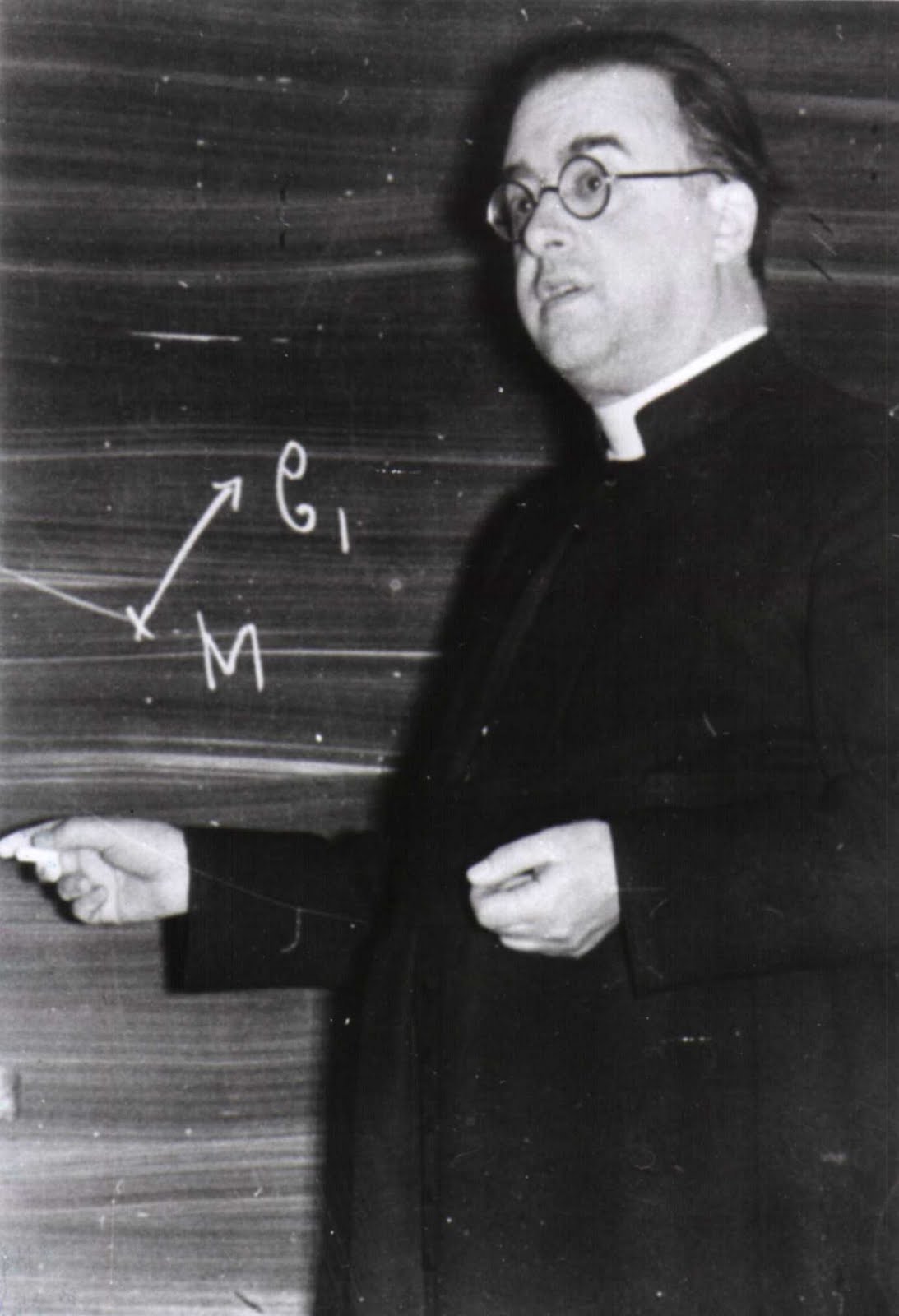
The idea of the "Big Bang" developed in the late 1920s and early 1930s. Although many in the early 21st century teach and believe that the "Big Bang" is scientific fact, it is really the chief theory proposed by many cosmologists to explain what is physically observed by various telescopes. Ironically, the concept of the "Big Bang" first was conceived by Georges Lemaître, a Belgium Roman Catholic priest, in 1927. Lemaître called his theory, "hypothesis of the primeval atom," while his detractors called it "Big Bang."(Fred Hoyle, who rejected Lemaître's theory, coined the term "Big Bang.")  Lemaître's "hypothesis of the primeval atom" not only argued against the prevalent theories of his day but also was viewed as being too "religious" as Lemaître described the explosion of the "primeval atom" as the moment of Creation. Today, most people view the "Big Bang" as being science and against religion.

Monsignor Georges Henri Joseph Édouard Lemaître
At the time Lemaître proposed his "hypothesis of the primeval atom," few scientists accepted it. Albert Einstein said to Lemaître regarding his theory, "Your math is correct, but your physics is abominable." The prevalent theory held that the universe was static, a steady-state. This view of the Universe was first put forth by none other than Aristotle in Ancient Greece.  Favor toward the so-called "Big Bang" theory of the origin of the universe (the universe has a beginning and is perhaps cyclical) over the the steady state view of the universe (the universe is eternal), began to wane when Hubble observed that that the Universe appeared to be expanding in the early 1930s and was more or less defeated with the discovery of cosmic microwave background radiation in 1964.

Sky Map of Cosmic Microwave Background Radiation
Since the mid-1960s, nearly all astronomers and cosmologists have accepted the "Big Bang" theory as the origin of the universe. In late 20th and early 21st centuries, a number of cosmologists have begun to ask the question, "What was before the Big Bang?" Since by definition, the "Big Bang" is outside of space and time -- it is, according to the theory, the origin of space and time -- as a statement of causality to speak of "before" the Big Bang makes no sense. Yet cosmologists and physicists are wondering what caused the so-called "Big Bang" and what happened before it. Some have suggested that the universe is the result of multiple Big Bangs  or is a member of a multi-verse," a cyclical process by which the universe is recreated or goes through multiple births and deaths (it is really difficult to keep track of all the variant theories). Recently, Michio Kaku, cosmologist and co-creator of "String Theory," stated that his grandparents were Buddhists while he went to Sunday School, and the multi-verse view of the universe allows him to merge his Buddhist heritage (cyclical) with Christianity (beginning).

As previously stated, when science leaves the realm of description, it enters into theology. Modern cosmology (not as the descriptive science but in prescribing how and why) is a jumble of ideas dating from the earliest philosophizing of man. Is the universe eternal? Did the universe have a beginning or multiple beginnings? Is it cyclical? These ideas whirl in utter confusion.

Nicholas Copernicus
In 1543, Nicholas Copernicus published his De revolutionibus orbium coelestium (On the Revolutions of the Celestial Spheres) in Nuremberg, Holy Roman Empire of the German Nation. His book challenged Ptotlemy's view that the earth was the center of the universe by positing that the sun was the center. The earth went around the sun, rather than the sun around the earth. The Lutherans published his work, even though Luther apparently did not think much of Copernicus' ideas -- Melanchthon and others were intrigued by them.  The main theological concern regarding Copernicus' ideas was that it somehow diminished the earth and more importantly human beings as the special creation of God. Cosmologists today see the Copernican Revolution as pivotal in demonstrating,"It is evident that in the post-Copernican era of human history, no well-informed and rational person can imagine that the Earth occupies a unique position in the universe." (Michael Rowan-Robinson, Cosmology (3rd ed.). Clarendon Press, Oxford. pp. 62.)

Yet despite this "evident" fact that human beings do not occupy a unique position in the universe, cosmologists have noted since the early 1970s that there is a troubling anthropocentric principle in physics and cosmology. If certain physical constants were slightly different, life could not exist. If the earth were slightly closer or slightly further from the sun, life could not exist. If the sun itself were in a different position in the galaxy life could not exist and so on. In fact, the entire universe seems to favor the existence of life on earth. (Of course, some of us know.)

This brings me to the book The Goldilocks Enigma: Why Is the Universe Just Right for Life?


Wednesday, June 8, 2011

Scandinavian Trip


Alf Danbold, Dan Gilbert, Daniel Preus, Joel Lehenbauer in front of the Palace of the King of Norway. (Torkild hosted us at his home in Norway.)

I write as I wait for the bus to the airport. Yesterday, we held round two of theological discussions between the Lutheran Church in Norway and the LCMS in Oslo, Norway. Round one was held on 15 April 2011 in Saint Louis.

The discussions went well and there is great unanimity in
doctrine. Some further work needs to occur to determine the next course of action.


Flying into Götenborg, Sweden.

The previous day, Daniel Preus and flew to Götenborg to meet with Bishop Gustafsson, Rev. Dr. Bengt Birgersson, and Rev. Jakob Appell of the Mission Province of Sweden and Finland. The outcome of this brief meeting was that there should be further discussions between the Mission Province and the LCMS.


Rev. Dr. Bengt Birgersson

This trip to Scandinavia was very edifying and productive. We had opportunity to meet with other fine Confessional Lutherans such as Rev. Jan Bygstad of DELK (Norway) and Rev. Dr. Fredrick Sidenvall of Sweden. In fact Dr. Sidenvall hosted us at his home in Götenborg on the Swedish national holiday on June 6.


Daniel Preus and Jan Bygstad at the home of Dr. Sidenvall.


The skyline of Oslo, Norway.

On my way to the airport I reflect on how the Lord has preserved his church through out the world utilizing the confession of his faithful people.

A quick return to the USA and then off to South Korea and Japan.

"Built on a rock the church doth stand... Even when steeples are falling..."

- Posted using BlogPress from my iPhone

Location:Manglerudveien,Oslo,Norway

Sunday, May 29, 2011

The Everlasting Man

G.K. Chesterton
In honor of my upcoming trip to Sweden (more on that later), I began to re-read Hammer of God. In the Preface to Hammer of God, G.K. Chesterton's book The Man Who Was Thursday was mentioned as "urgent reading." While I had "read in" Chesterton before (after all, he has some great quotes), I really haven't read him before. You can read all about G.K. Chesterton in Wikipedia. Apparently, the man was most often seen with either a cigar or a pencil in his hand.


This afternoon I had several yard projects to do -- mulching, bush trimming, grass cutting (which finished just before 9 PM with the tractor lights on), and other tasks. When doing such outdoor work, I like to listen to books. The Everlasting Man by G.K. Chesterton was available as a free audiobook download. 

The Everlasting Man, first published in 1925, is a response or reaction to H.G. Well's Outline of History, in particular to Well's view of both history and his evolutionary approach to man. The Everlasting Man is a two-part history: man before Christ, beginning with the so-called "cave man" and man after Christ. In response to evolution, Chesterton's basic thesis is that if man is just an animal, he is an extraordinary animal. Ironically, despite being 86 years old, Chesterton has both cogent and witty arguments against modernism.

You can read more about The Everlasting Man at Wikipedia and download the text here from Gutenberg Austrialia, or see an embedded PDF below the audio.

If you care to listen to the book, you can download the audio from here or listen to it stream below:


Everlasting Man

Saturday, May 28, 2011

1856 Ordination Rite Translation


1856 Ordination Rite Translation
Translator’s Note:
The text below is a translation of the German Church-Agenda for the Evangelical Lutheran Church Synod of Missouri, Ohio, and other states.
Kirchen-Agende für Evangelisch-Lutherische Gemeinden. (St. Louis: Druckerei der Deutschen Ev. Luth. Synod, 1856).
The ordination rite is taken from pages 171 – 176 of the aforementioned book. The numbers appearing in brackets [ ] correspond to the original page numbering of the Kirchen-Agende.
The aforementioned Kirchen-Agende was translated into English in 1881; however, the translation omitted several parts including the ordination rite translated in this document.
Church Liturgy for Evangelical Lutheran Congregations. (St. Louis: Concordia Publishing House, 1881).
 Albert B. Collver, III
1998 Epiphany 5


Ordination


The ordainer steps with his assistant to the altar. On the steps of the altar stands the one to be ordained. At the conclusion of the song, the ordainer and his assistant turn around facing toward the one to be ordained and the first one says:

Our Lord Jesus Christ said after his resurrection to his disciples (John 20): “Peace be with you! Just as the Father sent me, also I am sending you. And when he said this, he breathed on them and said to them, “Receive now the Holy Spirit! Whomever’s sin you remit, it will be remitted to him and whosoever you retain, to that one it will be retained.”
And later before his Ascension he said to them (Matt 28): “All authority in heaven and on earth has been given to me. Therefore, go there and teach all peoples and baptize them in the Name of the Father and of the Son and of the Holy Spirit, and teach them to hold all, which I have commanded you. And behold, I am with you all the days until the end of the world.”
And after he ascended above all heavens, so that he fulfilled all things, he appointed some as apostles, some as prophets, some as evangelists, some as shepherds and teachers, that the saints would be prepared, for the work of the Office, so the body of Christ will be built up. (Eph. 4:11ff.)
Therefore the office, which preaches reconciliation, is setup by the Lord himself. The office is of the Spirit, who judges the living and the dead. The office of the New Testament is not held by one who is fit of himself, but he who is fit is [fit] because of God. They are ambassadors in the stead of Christ, God admonishes through them, and they bear God’s office full of exuberant clarity. (2. Cor. 3:5)
Therefore you ought also to adorn it in all respects, as St. Paul wrote to Timothy and Titus. For a bishop should be blameless, a man of one wife, who has believing, obedient children with all respectability, who administers his own house well (but if someone does not know how to administer his own house, how will he provide for the congregation of God?). [172] [A bishop ought be] not stubborn, not angry, sober, moderate, not a wine swiller, not a braggart, not dishonest working with his hands, virtuous, pure, chaste, just, holy, hospitable, kind, not a brawler, not avarice, gentle, not a novice, so that he does not puff himself up and fall into the judgment of the Blasphemer, apt to teach, because he holds on to the Word, which is certain and able to teach, so that he be able to exhort through the salutary teaching and to reprove the gainsayer. He must also have a good reputation from those who are outside, so that he does not fall into disgrace and the Blasphemer’s trap. He should persist with the reading, with exhortation, with teaching and not disregard the gift, which was given to him through the prophecy with the laying on of the elder’s hands. He should wait, [and] contemplate, so that he will increase in all things manifest. He should have concern for himself and the teaching and remain steadfast in his task. For in whatever he does, he will bless himself and his hearers. – Most of all in the same way the holy Apostle in his exhortation to the elders called to Ephesus (Acts of the Apostles 20.) recently united, thus he said, “Thus, now take care of yourself and of the flock, which the Holy Spirit has appointed you under as bishop, to tend the congregation of God, which he purchased through his blood.”
All this makes plain for you, what a high and holy office this is, into which you were called, and that what the Apostle said is certainly true, “Whoever desires the office of bishop desires a wonderful work.”

Here the one to be ordained kneels down.

Therefore, I ask you now, beloved brother in the Lord Jesus Christ, before the eyes of God, our Lord Jesus Christ and his holy angels, also in the hearing of this congregation, whether you, after careful consideration are ready to take upon you this holy office, and according to the ability that God gives [unto you], to execute and administer [it] according to every pleasure of the Lord and Arch-Shepherd of this congregation?

Answer:

Yes, I am willing after earnest consideration for the holy office, which God has called me to be placed upon me; I solemnly vow and pledge before God and his congregation [173] according to the ability that God gives to execute and administer it according to every pleasure of the Lord, the Arch-Shepherd and Bishop of Souls.

The ordaining pastor continues:

But do you also confess that you are obliged to carry out in accordance with his office, in the three chief Creeds of the church, the Apostles, Nicene, and Athanasian, as in the unaltered Augsburg Confession, the Apology, the Smalcald Articles, both catechisms of Luther and the Formula of Concord are found a pure and correct explanation and exposition of God’s Word and Will? And are you willing to execute on account of this your office according to these confessional writings of our holy church and to do this to your death?

Answer:

Yes, I confess the three chief Creeds, the unaltered Augsburg Confession, the Apology, the Smalcald Articles, both catechisms of Luther and the Formula of Concord as the pure, correct explanation and exposition of the divine Word and Will; I confess the same as my own confession and intend to perform my office until my death truly and diligently in the same way. May God strengthen me through his Holy Spirit! Amen.

The ordaining minister speaks again:

Upon this your promise before God and us, we ask God, the Father of our beloved Lord Jesus Christ, the one Lord of the harvest, that he, who called you to his Office, make you able through his Holy Spirit. May he grant, that you give no one offense, lest in this way the office is slandered, but demonstrate yourself in all things as a servant of God, in great patience, in afflictions, in needs, in anxieties, in beatings, in imprisonments, in tumults, in work, in watching, in fasting, in chastity, in knowledge, in long-suffering, in friendliness, in the Holy Spirit, in pure love, in the Word of Truth, in the power of God, through the weapons of righteousness in the right hand and in the left hand, through honor and dishonor, through malicious rumors and good rumors, as a seducer and yet truthful, regarded as unknown and yet known, as dying and behold, you live, as beaten, and not yet killed, as [174] a mourner, but at all times cheerful, as poor, but making many rich, as having nothing, but yet having all things. (2 Cor. 6.) The Lord gave you, therefore, to endure and to do the work of an evangelistic preacher, that you may be able to appear on that great day before the judgment seat of our Lord Jesus Christ, to give a common answer, to the strict and just judge of the living and the dead, to receive praise and honor out of his hand and to shine as the heavenly splendor and as the stars forever and ever!

Next the assisting ministers lay hands on [him] and each speak a biblical wish.

Then the ordainer speaks again.

We consign you now through the imposition of our hands to the holy office of the Word and Sacraments of God, the Trinity, ordain and consecrate you to the service of the holy church in the Name of the Father, of the Son, and of the Holy Spirit!

The other fellow ordaining ministers answer:

Amen. Amen.

Then all the ministers pray together:

Our Father … forever and ever! Amen.
The ordainer again:

Let us pray! Merciful God, heavenly Father, you have spoken to us through the mouth of your dear Son, our Lord, Jesus Christ. “The harvest is great, but the workers are few – pray to the Lord of the harvest, that he send workers into the harvest.” By this your divine command we pray from the heart, that you would give abundantly this your servant together with us and everyone, whom you called to your office, your Holy Spirit, that we may spread your Gospel, continue truly and strongly against the Devil, World, and Flesh, in order that your Name be hallowed, your kingdom increase, your will be done. Put a stop also to all your enemies, who oppress your Name, destroy your kingdom, oppose your will, place a limit and end, and wherever your servants bear witness and work, distinguish your witness and the work of your hands to the glory of your most holy Name and to the Holy Spirit. Amen.

[175]

The ordainer says to the ordained:

Thus lead and tend the flock of Christ, that you have been entrusted with, and watch [it] well, not under compulsion but willingly, not for the sake of vile gain, but from the bottom of your heart, not as one who rules over people, but become an example for the flock; that you may receive the unfading crown as an inheritance when the Arch-Shepherd appears. The Lord bless you from above and make you a blessing for many, that you may produce much fruit and your fruit remain for eternal life!

The ordained answers:

Amen.

Afterwards one sings: “Lord God, We Praise You …” or “Now Thank We All …”, whereupon the Holy Meal begins with the Words of Institution. The ministers accompany the newly ordained to the Table of the Lord.

__________

If an already ordained minister enters a new parish, allow the installation of him to proceed in the same manner, only that the conferring [of the office] not happen in general, but after answering the questions one of the following prayers beneath the laying on of hands is spoken, and after that: “Go Now To That Place …”

__________

Two Prayers

For use after the answering of the installation questions.

1.

Merciful God, heavenly Father, you who have fatherly comforted and promised us through your holy apostle Paul, that it is your good pleasure, O heavenly Lord and Father, to save all who believe through the foolish preaching of the crucified Christ. We pray from the bottom of our hearts, that you would bestow with Divine grace and grant and impart to this your servant, whom you have called to your Holy Preaching Office, your Holy Spirit. In the same way grant and impart strength to him against all trials of the Devil and make him wise and able to lead, your costly bought sheep with your salutary and true Word according to your divine will to the praise and glory of your Holy Name, through Jesus Christ! Amen.

[176]

2.


O Lord Jesus Christ, you the eternal Son of God who sits on high at the right hand of your heavenly Father, give gifts to the men on earth and send them shepherds and teachers, that Holy men be prepared for the work of the office and the building of your spiritual Body: we say from the heart to you praise, honor, thanks, that you have given your congregation once more a shepherd, and we pray that you would bestow your Divine grace to him and to us, that we may do what is due to you, to maintain faith and good conscience until death and obtain eternal life with all the elect. Amen.

The assisting minister receives a kind of ordination, as pastor, each case with respect to the congregation, whom he should serve chiefly, and where possible in their midst.

On the day of ordination or installation, the new pastor does not preach, but his entrance speech follows on the immediate following Sunday.

__________

The Lord bless you and keep you!
The Lord illuminate his face upon you and be gracious to you!
The Lord lift up his continence upon you and give you peace. Amen.


Originally posted on Logia's Blogia  (click here for original link).

__________

Original German Below.

Ordination 1856 MA German

Friday, May 20, 2011

Commence 2011 CTSFW


Commencement Brochure


Dr. Scaer with President Harrison before commencement.


President Harrison with Dr. Wilhelm Weber, Jr., from South Africa. Dr. Weber is the father of Bishop Weber of the Lutheran Church South Africa (LCSA).


Rev. John Halakhe, General Secretary of the Evangelical Lutheran Church in Kenya (ELCK) receiving the Master of Arts degree.


Halahke, Collver, Quill after ceremony.


Alexei Streltsov from Siberia Russia receiving his Master of
Sacred Theology degree.


Tapani Simojoki from England receiving his STM.


Dr. Gennadij Khonin from Kazakhstan received his D.Min.


President Matthew Harrison receives Doctor of Divinity.


Dr. Wilhelm Weber from South Africa receives his Doctor of Divinity.


Dr. Dean Wenthe, President Emeritus of Concord Theological Seminary, receives Doctor of Divinity for his many years of service.


Flags representing the countries of students who received degrees.


Dr. Larry Rast, academic dean of CTSFW.


President Harrison's executive staff -- Barb Below, Kim Vieker, John Vieker, and Albert Collver after the commencement.

SDG

- Posted using BlogPress from my iPhone

Location:St Joe Center Rd,Fort Wayne,United States

Thursday, May 5, 2011

Greetings from India


Rev. J Sudhakaran, Comptroller of the India Evangelical Lutheran Church (IELC), Darin Storkson, LCMS, Rev. J. Samuel, President of the India Evangelical Lutheran Church (IELC), Rev. Albert Collver, LCMS Director of Church Relations.
President Samuel of the IELC with Rev. Sudhakaran are in Saint Louis for discussions. The India Evangelical Lutheran Church was the first mission efforts of the LCMS. The first LCMS missionary arrived in India in 1894. It is a great honor and privilege to have President Samuel and Rev. Sudhakaran with us at the International Center.


Wednesday, May 4, 2011

"Blessings, Gifts, and Challenges" -- May 2011 Lutheran Witness


The May 2011 Lutheran Witness is hot off the press. You can get it from the Lutheran Witness site. (Download here). President Harrison begins the issue:

"At my request, The Lutheran Witness staff has put together this issue to inform the good folks of Synod about the financial realities that we face. The funding of this multi-billion-dollar institution called The Lutheran Church—Missouri Synod is complex, to say the least. It took me a good five to six years working at the International Center before I actually began to understand it. The first step in addressing a challenge is honesty about its existence and its probable causes. But this must be done with an eye on our blessings, which are truly extraordinary. We are in a definite predicament, but it’s hardly all doom and gloom."

Articles Include:

  • From the President -- Matthew C. Harrison
  • The Constancy of Change -- Larry Rast
  • Body and Soul Work -- Albert B Collver / Kim Krull
  • Mission Heritage -- Kim Krull
  • Fan Into Flame -- Kim Krull
  • Righting the Financial Ship -- Kim Krull
  • The Lord Gives Christians Manage -- Jerald Wulf
  • LCMS Agencies
  • LCMS Seminaries -- Roland Lovestad
  • LCMS Schools -- William Cochran
  • The Concordia University System -- Adriane Dorr
  • Witness, Mercy, Life Together, and Restructuring -- Albert Collver
  • The Future Is Here -- Barbara Below

All in all, I think it makes for a fascinating read.


0511 Witness