Search This Blog

Friday, November 26, 2010

O Christmas Tree, Black Friday, Thanksgiving 2010

Kit and Grandpa Preparing to Cut Tree Down
On so-called "black" Friday, our family followed a long standing tradition of going to cut down a Christmas tree in Tennessee, near House Mountain. The selection of trees was rather limited due to a drought that killed nearly 3,000 trees this year.  Nonetheless, we managed to find a Christmas tree.


The video was shot and made on my iPhone 4 using iMovie for the iPhone. Amazing what this little device can do.

We cut our tree at T-n_T Tree Farm. T-n-T Tree Farm is owned and operated by Douglas and James Toliver. White pine, Virginia pine and Scotch pine are all available, and this farm will be open daily from November 23 to December 22. Hours are Monday thru Friday from noon till dusk, Saturday from 9 am till dusk, and Sunday 1 pm till dusk. Wreaths are also available, and hot drinks are served to patrons. T-n-T is located at 8237 Millertown Pike, Knoxville, Tennessee 37924. Feel free to contact them for any questions at 865-932-0658 or 865-919-8118. Also, they can be reached by email at motrick@aol.com.

Sun setting behind the ridge
Here are a few other photos.

Wednesday, November 24, 2010

Worldwide -- Witness, Mercy, Life Together

Sign on Silesian Lutheran Headquarters

This post is much less about the Silesian Lutherans that I have written so much about lately, and more about the Synodical Emphasis of Witness, Mercy, and Life Together. One thing I have noticed in my travels to various churches throughout the world is that nearly every church focuses on three areas summarized by witness, mercy, and life together. Various churches do not necessarily call their work by these names, nonetheless, this is the work that they do. I was rather surprised (and pleased) when I saw that the Silesian Evangelical Church of the Augsburg Confession had an evangelism department, a diakonia department that is celebrating its 20th year, and a church fellowship department.

Evangelism (Witness) Area of Silesian Church
Witness Emphasis for LCMS

In John 1:19 - 20, the words for witness (martyria) and confess (homologein) are used interchangeably. For the past several years or so, it seems as if the Missouri Synod has been engaged in a struggle over "evangelism / witnessing" and "confessing / remaining confessionally faithful." St. John, the Evangelist, shows that "witness" and "confession" are synonyms and that they belong together. A person cannot witness the truth unless the confession is correct and orthodox. A person retain the orthodox confession without bearing witness to it. Witnessing and Confessing are two sides of the same coin. In ecclesiastical terminology, a "martyr" is a person who gave his or her life bearing witness to Jesus. A "confessor"is a person who did not lose his or her life but who stood before the authorities, kings, or governors and confessed the truth about Jesus at risk to life and limb. Therefore, Robert Barnes is a confessor and martyr, while Martin Luther is only a confessor. Ignatius of Antioch was a martyr, while Cyril of Alexandria was a confessor. Witnessing leads to confessing and confessing leads to witnessing.


Diakonia (Mercy) Area of Silesian Church

Mercy Emphasis for the LCMS

Church Fellowship (Life Together) Area for Silesian Church
Life Together Emphasis for LCMS
In the Missouri Synod, it seems that every new Synodical President brings a different emphasis, slogan, or program to the church. In some ways, this is inevitable and not entirely bad. The time in which a given President serves requires that Law and Gospel be divided for the church at that time and for him to focus on what he believes is most necessary at that moment. This is simply providing pastoral care to the Synod as a whole, not unlike what a new pastor does upon arriving in a congregation. President Harrison's office has strived to not call Witness, Mercy, Life Together a program or slogan, but rather an emphasis. Witness, Mercy, Life Together isn't really anything new. It is really just what the church does as she lives under the cross of Jesus. What these areas are called isn't ultimately important, simply that the church carries these out. The example from the Silesian church shows that Missouri Synod isn't alone in the task but the Christian church throughout the world engages in Witness, Mercy, and Life Together -- even if different church bodies and groups of Christians call it something different.


Sunday, November 21, 2010

Silesian Diakonia Work


Here are some photos of the diakonia work in Silesia. They are celebrating 20 years of work.

Monday, November 15, 2010

Technology Enhances But Doesn't Replace ... <fill in the blank> education


Today on the plane from Amsterdam to Detroit, I read a fascinating piece in Financial Times that has implications for theological education. The cartoon above is from the article. The article was titled, Technology Enhances But Doesn't Replace.

The article explores distance learning for MBA degrees. The author noted that surprisingly the demand for residential MBA programs has increased during the economic crisis. The expectation was that residential programs would decrease while online and distance programs would increase. However, the opposite happened.

The author explores why this might be. The author notes, "Learning in a group enables participants to pick up the subtleties of the interactions that are essential to management. The ability to understand not only what is said, but what is not, to negotiate and ultimately persuade is as important as having the right facts."

The point is that face to face interaction enhances the learning environment in a way that technology alone cannot. It isn't that a person cannot learn via distance education but that in general it is not the same as a residential program. The author concludes, "Online is better than nothing for those too constrained by cost or time to come together to learn. But that is a different kind of management degree."

The business world is now recognizing that there is value in residential programs for MBA degrees. If true for business, how much more so for residential theological education. Distance learning has it's place and is valuable but it is a different kind of theological degree than a residential program.

In any case, this is not a diatribe against distant theological education. Just some reflections, on how the business world increasingly values what it once thought unnecessary. Perhaps, a good lesson for us too.

- Posted using BlogPress from my iPad

Model for Church Government

One of the pastors in the Czech Republic asked me why the Missouri Synod called its bishop "president." The assumption was that a conservative church body would use traditional language. I explained some of the history of the Missouri Synod and Bishop Stephen, etc. And that seem to help in the understanding.

However, I was recently struck by a Herman Sasse quote -- where he says in Europe, church government is modeled after the State. In America, church government is modeled after the corporation or business. This is an interesting observation. The church is always at tension in this world and will pick up characteristics from one thing or another. Historically in Europe it was from the government while in America it was business.

Here is the Sasse Quote:

"The church administration in Europe follows the patterns of the administration of the state, while in American the great business organizations seem to be unknowingly imitated by the churches. The consequence is that also the parish minister becomes more and more of an administrator and organizer who rushes from meeting to meeting and has not enough time for his proper calling as a shepherd."

 -- Hermann Sasse

Sunday, November 14, 2010

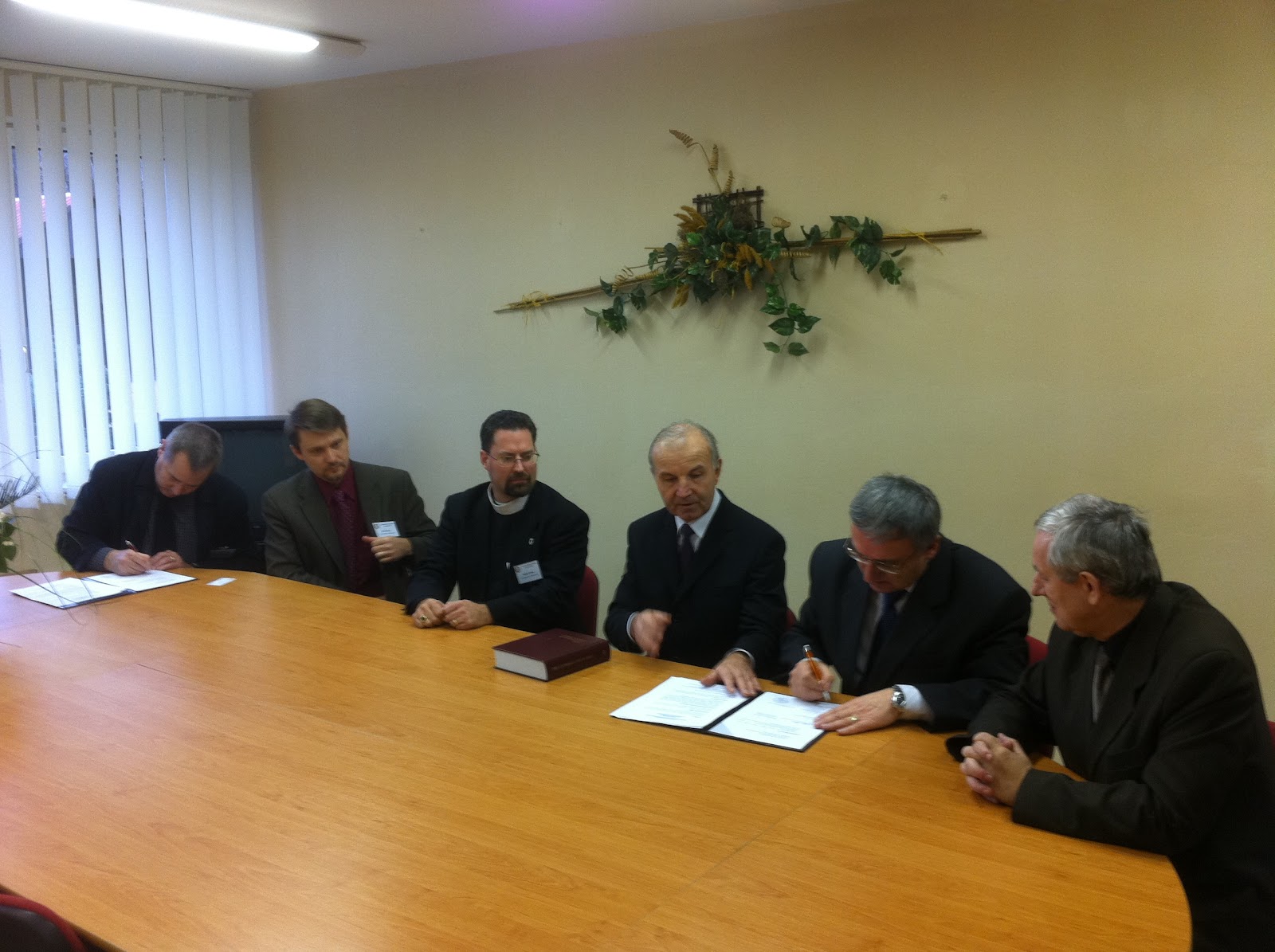
Working Agreement with the Silesian Evangelical Church of the Augsburg Confession

Bob Rosin, Brent Smith, Albert Collver,
Bishop Stanislav Pietak, Bishop Jan Waclawek, Adam Cieslar
Sign Working Agreement
Working Agreement Between the SCEAV and LCMS
On Saturday, 13 November 2010, a working agreement between the Silesian Evangelical Church of the Augsburg Confession (SCEAV) and the Lutheran Church-Missouri Synod (LCMS) was signed. Now this working agreement did not recognize no differences in doctrine, nor did it enter the two churches into pulpit and altar fellowship. This agreement calls for the two churches to have regular contact between the church leadership, the holding of theological lectures and convocations, and invitations to each other's theological presentations. There is a call for cooperation in diakonal work -- in fact, the LCMS has worked with the SCEAV in diakonal projects before this agreement. At the convention, Bishop Pietak thanked the LCMS for the working together in diakonal projects (a future post will show one of the SCEAV's diakonal projects). The hope of the agreement is that further contact between our two churches will "give us the opportunity to more fully realize our unity as Lutheran Christians so that on the basis of agreement in doctrine and practice the two churches may share full altar and pulpit fellowship." The LCMS' working agreement is modeled after the agreement SELK (our German partner church) has with the SCEAV.

The City Church is next to the headquarters of the SCEAV
The SCEAV Synod Convention opened with worship in the city church. This congregation is simply known as the city church.

The Sanctuary of the city church

A Czech Hymn with a familiar melody

Brent Smith, Bishop Pietak, Albert Collver, Bob Rosin in the city church
In the SCEAV's convention, we were able to hear some of the projects they are working on and the challenges and struggles they face. The SCEAV has about 35 pastors, 100 church workers, 21 congregations, about 15,000 members who regularly attend church and another 15,000 members who attend for baptisms, weddings, and funerals. Despite being much smaller than the LCMS, the SCEAV and LCMS face many of the same struggles -- faithfulness to the Scriptures and the Confessions, decreasing gifts and offerings, etc. In one of the papers presented to the convention, Pastor Marek Rican focused on three areas of emphasis and challenges for the Silesian church: 1) the Sacraments -- regular use and the belief in the real presence, 2) Law and Gospel distinction, and 3) Lutheran identity.

Voting at the SCEAV Convention
Voting is much simpler at the SCEAV convention -- a numbered piece of paper raised in the air. Unlike LCMS conventions, there were no jokes, training sessions, or complaints about "electronic" voting. No tutorial was needed -- just raise your hand with your number.

It was a great experience and privilege being invited to attend the SCEAV Synod Convention.

Saturday, November 13, 2010

Works of Mercy and Church Unity


Here is an article in the Fall 2010, Concordia Journal, that I wrote titled, "Works of Mercy and Church Unity: Does Service Unify and Doctrine Divide?" The article does trace out the term "cooperation in externals" and offers a suggestion on the circumstances or boundaries for cooperation in externals. The entire Fall 2010 issue of Concordia Journal can be downloaded here.

Works of Mercy and Church Unity CJfall10